
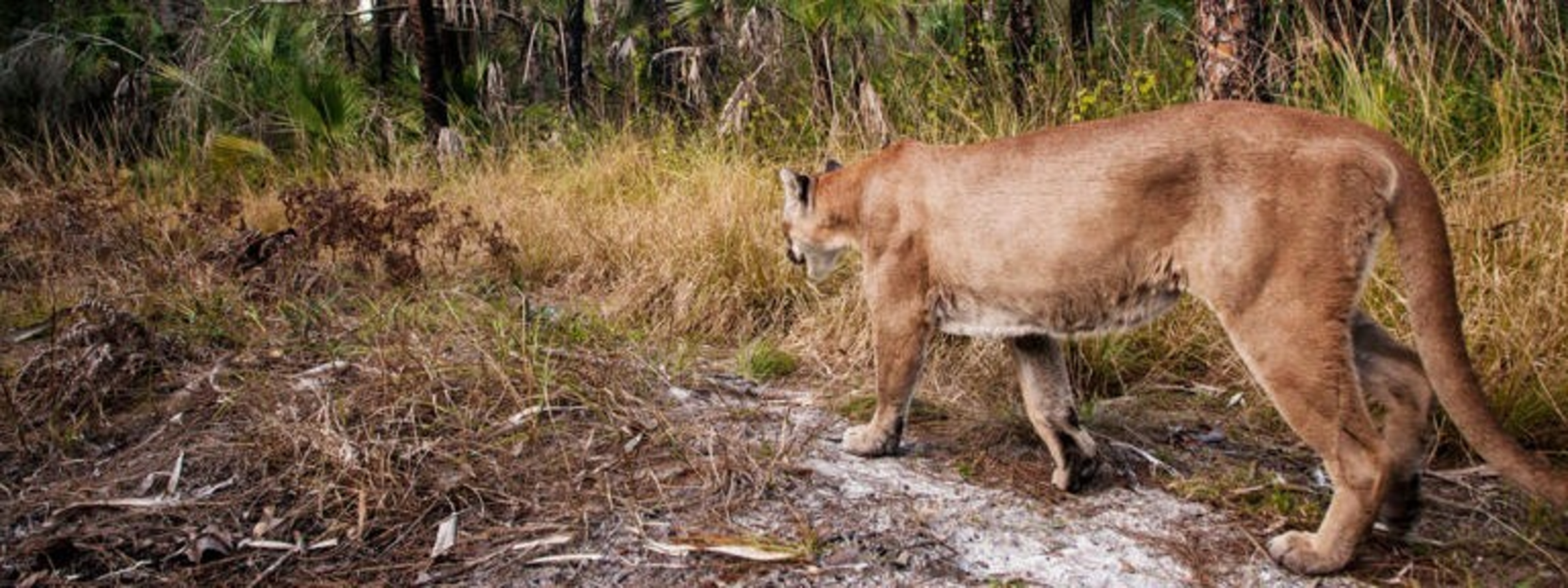
The Florida panther. No, not the hockey team, the state's biggest cat. Can it survive?
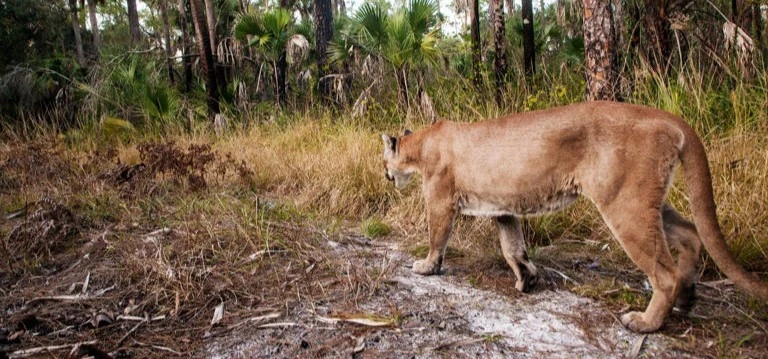
A new article from the Palm Beach Post by Amy Bennett Williams:
Collier County is the Florida panther capital of the planet.
And while Palm Beach County is often referred to as the world's golfing capital, Collier County on Florida's Southwest coast actually boasts more holes per capita than anywhere else.
So maybe it shouldn’t have been a surprise when a young female panther decided the Naples Heritage Golf and Country Club would be a good place to raise a family. She settled in, denned up and gave birth to three kittens: two females and a male in March of 2022.
Most of the big cats stick closer to the county’s wild interior of preserves, farm fields and ranches. But even in Florida's biggest county by size (Palm Beach County is the second-largest) as human habitat swells ever closer to theirs, such intimate intersections are bound to occur, says panther biologist Dave Onorato, with the Florida Fish and Wildlife Conservation Commission. "There have been at least two more (golf course litters) in the urban/wilderness interface," he said.
Florida panthers: Feared, hunted and still hard to find
For decades, these rawboned buckskin cats have threaded their way through swamp, scrub and the Sunshine State's psyche. Viewed by some as the very spirit of wild Florida, to others, they're an expensive nuisance or a government boondoggle.
Federally listed as endangered since 1967, Puma concolor coryi, once ranged north through Georgia, Alabama and Mississippi west to Louisiana and Arkansas. Then humans changed that, first with rifles (in 1887, Florida law authorized a $5 payment per panther scalp), then bulldozers, then cars, their leading cause of death today.
Now, between 120-230 remain, according to the commission, despite being notoriously tough to count.
"Panthers are rare and elusive, making them difficult to enumerate," Onorato says. "Also, they range across a vast part of south Florida on public and private lands, making assessments of the population size a challenge."
"However, we can say with confidence that that abundance and distribution of panthers in South Florida, especially the breeding segment of the population, has increased and expanded significantly over the past decades since recovery efforts began," said David Shindle, the U.S. Fish and Wildlife Service's Florida panther recovery coordinator,
What's also certain is that most are centered in and around Collier County, where the 26,605-acre Florida Panther National Wildlife Refuge is headquartered. Smaller than the nearby Big Cypress (729,000 acres) and Fakahatchee Strand (75,000 acres) preserves, it's nonetheless a key piece of the panther recovery puzzle.
On a late July morning, cicada buzz swells and falls as Shindle crouches in a drying mud track, pointing at a faint half-moon dent left by a panther pad — likely a female's — that only an eye as finely trained as his would have spotted. She's one of at least four females with kittens that use the refuge, as well as adult males, who need territories up to 200 square miles.
Two decades ago, Shindle would have considered the refuge's southeast corner the geographical center of the cats' breeding population, but that's changed, he says. "We have witnessed a northward expansion of the breeding population, including into areas north of the Caloosahatchee River." These days, he says, he'd move the map pin to the area immediately east of Immokalee.
The panthers' tenuous success is chronically menaced.
In the early 2000s, an outbreak of feline leukemia, an often-lethal viral disease familiar to housecat owners, killed five panthers.
Then in 2017, biologists started noticing staggering panthers and bobcats with wobbly hind legs, some so disabled they had to be euthanized. First seen in cats around Corkscrew Swamp Sanctuary in Collier County, the malady didn’t even have a name at first. FWC veterinarian Mark Cunningham told The News-Press in 2019, “We termed the condition feline leukomyelopathy (often shortened to FLM) based on the microscopic changes seen in the brain and spine. We continue to learn more about it but have not yet determined a cause, as well as what can be done to prevent further panthers from acquiring the disease."
Since then, "75 cases (31 panthers, 44 bobcats) have been diagnosed in peninsular Florida," the FWC says.
Scientists have investigated infectious diseases, toxins, and other possible causes, Shindle says, but so far, nothing looks like a sure bet.
Meanwhile, cases of FLM continue to be documented by FWC, Onorato says, "but we have not seen an uptick in cases over the past several years. FLM continues to be a priority research topic for FWC so that we can try to understand the root cause of the disorder."
Once they've re-established in South Florida, then where?
Population expansion, or more accurately, re-population, is key to Florida panther survival.
"There is sufficient habitat to accommodate the continued natural population expansion into Central Florida, which would mean more cats crossing and breeding north of the Caloosahatchee," Shindle said. "There are also significant areas of habitat in North Florida that could support additional populations of panthers, but obviously it would take some time for natural expansion to occur in North Florida."
Florida’s panther population may be increasing, but compare that with the thousand or so humans that arrive in the Sunshine State every day needing habitat as well. All those people are eating into the land panthers could use, covering it with homes and slicing it with roads, which is where most panthers die.
Yet people are trying to help too.
With unanimous bipartisan support, Florida’s Legislature approved the Wildlife Corridor Act in 2021, designed to protect some 18 million acres of habitat ranging from traditionally preserved land to working ranches with conservation easements.
The only way for Florida panthers to get off the endangered species list? The U.S. Fish and Wildlife Service’s answer to that question has varied, but the goal is usually at least two (sometimes three) “subpopulations that total 240 individuals. There must be exchange of individuals and gene flow among subpopulations.”
But it's hard to say.
The document that holds the key is now a decade overdue, and some advocates have said they worry it may trigger the removal of protections.
The fears stem in part from questions about panther genetics: Is the Florida panther a distinct subspecies, or have various infusions of out-of-area blood, as the government did with eight female Texas cougars in the mid-90s, created another cat entirely? The introductions sparked angry taxonomic and semantic hair-splitting (you can sometimes tell how people feel about the matter by whether they call the cats panthers, pumas or cougars) but it was a smashing success in terms of reinvigorating the population, which had been enfeebled by inbreeding.
Contiguous green space is the last, best hope for Florida panther survival, many advocates say. In recent years, the wildlife corridor concept has caught fire, bolstered by ranch-rooted Florida wildlife photographer and National Geographic Explorer Carlton Ward, who's become an ambassador for the effort. "The survival of the Florida panther depends on the protection of a network of statewide public and private lands, known as the Florida Wildlife Corridor. This network of land gives the panther hope for rebounding its population and recovering some of its historic range."
The Ward-produced documentary "Path of the Panther" introduces viewers to the challenges and opportunities they face, while making a plea for connected territory, which would benefit myriad species; not just panthers.
FLM could spell trouble. Although females have crossed the Caloosahatchee and produced litters there, some of the kittens appear to have disappeared. "If the loss of one or more panther litters north of the Caloosahatchee River was attributable to FLM, this disease would present a threat to the expansion of the Florida panther population," Shindle said.
As if disease weren't enough, invasive snakes may be taking a big bite out of panthers' preferred prey. The eating machines that are Burmese pythons threaten all warm-bloods with fur, including white-tailed deer. "Although the extent of the python’s impact on the white-tailed deer population is still being investigated, the number of deer hooves removed from the digestive tracts of pythons in Southwest Florida provide sufficient evidence that the threat is one we should take seriously," Shindle said.
Shoot, shovel and shut up'
There's another challenge: human animosity. Just as attempts to reintroduce wolves and grizzly bears to areas where they'd been wiped out, some people just don't want panthers around, threatening their Havaneses and Herefords and competing for their deer come hunting season. "It's just the kind of thing that large carnivores evoke in people," Onorato said.
Some people take matters into their own hands, employing what Shindle calls the 'shoot, shovel and shut up' approach.
For ranchers who worry about losing stock, Florida launched a trial program earlier this year to pay for panther-killed cattle. They don't even have to produce a carcass, says Zachary Wardle, a panther biologist who helped develop Florida's panther depredation compensation pilot project; all that's required is something that ties the loss to a panther. "We don’t need to have a smoking gun as long as it seems probable," Wardle said. "We’ll still write folks a check."
Tied to the price a weaned steer would fetch at auction, as of August, that check would be about $1,700. So far, none have gone out since the program started in October. Why? Wardle's not sure.
"We wonder if some folks think it’s not worth their time," he says, though the agency has worked hard to make the process quick and easy. Maybe the seasonality of calving could be a factor, he says: "Because calves aren’t hitting the ground during the hotter months." But he's hopeful. "It's funded for a few more years. We're hoping to provide proof-of-concept."
In any case, having ranchers and large landowners on board will be key to a panther comeback, Wardle says. "We like to tell folks that the public lands alone can’t sustain a healthy panther population ; we need those lands with a variety of landscapes," from crop fields to pastures to timberlands. "Some folks might not realize that Florida’s rural and working lands provide important habitat."
In the works: another program that will pay landowners for leaving their land in a natural enough state to provide ecosystem services: groundwater recharge areas, homes for wildlife and the like.
Because if panthers, their wild kin and the places that support them are to survive, people have to help, Shindle says.
"All of the panther’s problems can be traced directly back to human-related impacts," he said. "In spite of these conflicts, the Florida panther, which represents the only breeding population of puma east of the Mississippi River, persists. But the panther still needs our help in conserving the habitats, including Florida’s working ranchlands, that support both the current population and that are necessary for the panther to achieve recovery statewide."
He suggests it's time to heed the wisdom of the late wildlife biologist Dave Maehr, author of "The Florida Panther: Life And Death Of A Vanishing Carnivore," who wrote: “The panther is holding up its end of the bargain. It’s up to us to the let the panther demonstrate a resiliency hampered only by limited space.”
How to help
Floridians can support panther conservation efforts by buying a “Protect the Panther” license plate, the primary funding source for the FWC’s research and management of Florida panthers. Learn more here: https://myfwc.com/wildlifehabitats/wildlife/panther/
Floridians can also support state land conservation programs, such as Florida Forever and the Rural and Family Lands Protection Program, that help secure the habitats, including working ranchlands, that the Florida panther needs for recovery.
This article originally appeared on Palm Beach Post: The Florida panther. No, not the hockey team, the state's biggest cat. Can it survive?