
13 Favorite Education Resources From National Geographic
National Geographic | Education Blog
Every year, millions of educators, students and curious minds from all around the world visit the National Geographic Society’s Education resource library, a collection of nearly 3,000 maps, articles, learning tools, infographics and more. Some of these resources have earned lasting popularity, such as Compass, Pollution and the ever-fascinating Great Pacific Garbage Patch consistently rank among the most popular resources in the collection. But these popular pages are only the tip of the iceberg!
The National Geographic Education team is constantly adding to, revising and curating the collection. From updated versions of old favorites to new MapMaker resources and articles written by our Explorers, there is always something new to see.
As we look forward to the year ahead, we asked the team for some of their favorite resources that they want our audiences to know about in 2025. Here are their top 13 classroom resources for educators and learners:
Stories about the world’s water are illuminated in these interactive MapMaker maps, developed from the work of National Geographic Explorer Marc Bierkens and his team at Utrecht University. One map details demand for water; another identifies gaps by examining how much usage is sustainable for the region’s rivers and groundwaters. Both maps also pinpoint stories about freshwater issues that learners have encountered in their own communities.
“This is such a rich and layered resource for teachers and learners. I especially love how the maps include points that feature the stories told by young people about freshwater issues in their own communities. Behind the scenes, this project was an enjoyable collaboration across several teams.” – Kate
2. Explorers at Work: Nick Okafor
National Geographic Explorer Nick Okafor built his career by pursuing an interdisciplinary path that combines STEM education and social justice. Today, his organization focuses on empowering students to use data and GIS to solve problems within their communities, whether students are mapping transgender voter discrimination or locating fast food restaurants in proximity to city high schools. Learn about Okafor’s journey and his project, Mapping Justice, and consider how maps illustrate interconnectedness, tell stories, identify problems, visualize data and implement solutions.
“I love how Nick’s work cultivates students’ imaginations. He makes STEM empowering and socially relevant for young people.” – Bayan
A less belligerent, but no less competitive, part of the Cold War was the space race. The Soviet Union bested its rival at nearly every turn, until the U.S. beat them to the finish line by landing astronauts on the moon.
“Human achievement has rarely been so competitive or inspiring.” – Clint
4. Reimagining History with Heritage Maps
Archaeologist and National Geographic Explorer Alicia Odewale uses archives, maps, artifacts, oral histories, and cultural landscapes to explore the history of the Historic Greenwood District in Tulsa, Oklahoma.
“This product showcases Alicia Odewale’s use of mapping to reimagine the history of life in all-black towns in Oklahoma in the early 20th century. This is a case where little-known African-American history is brought to light by an NGS Explorer.” – Jean
5. Police Stops: Borders and Power on a Walk Across Earth
National Geographic Society and Explorer Paul Salopek developed this Explorer Mapping Case Study using the Explorer Mapping Case Study organizer to learn more about the role borders and police power play across the world.
“Paul is always a delight to work with, and from our interactions, I never would’ve guessed at the legal difficulties he’s faced on his journey. Reading the commentary on each stop gives you a brief snapshot of the complex geopolitical issues in each area.” – Bayan
6. Environmental Refugees (Margot)
Climate refugees are people who must leave their homes and communities because of the effects of climate change and global warming. Climate refugees belong to a larger group of immigrants known as environmental refugees.
“This article offers a great overview of a globally relevant topic, especially in such a rapidly evolving world and changing climate.” – Margot
7. MapMaker: Florida Wildlife Corridor
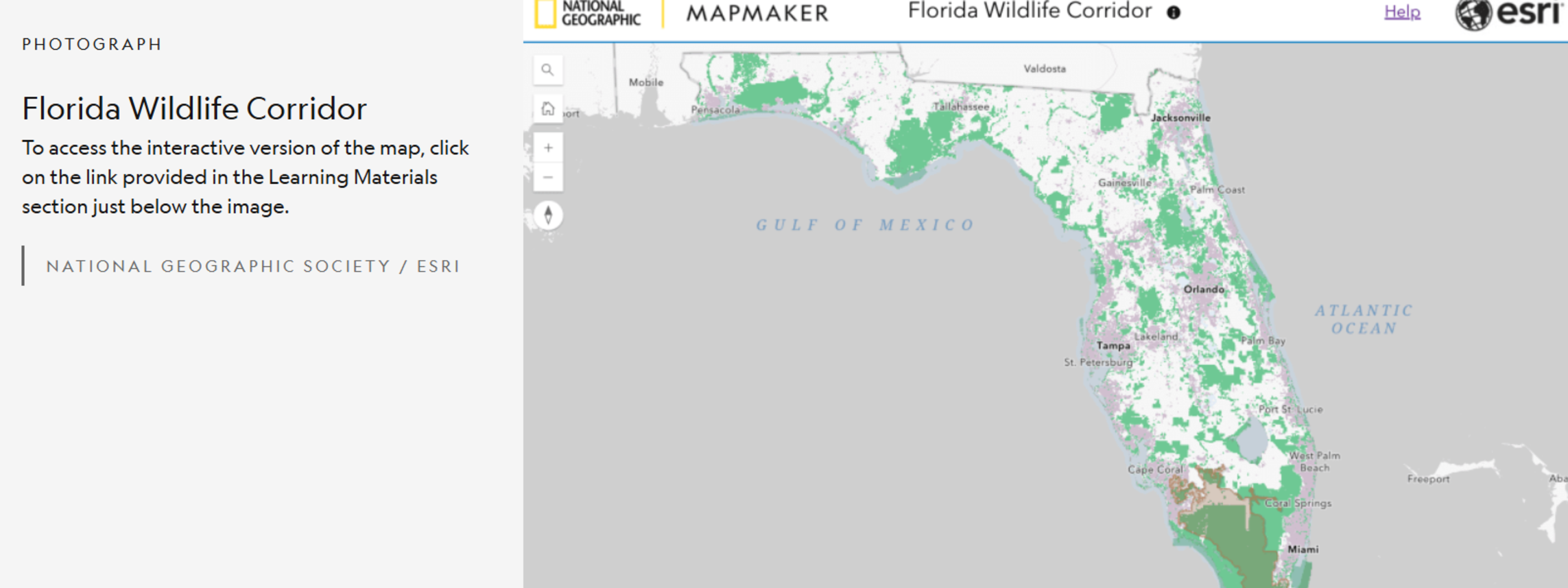
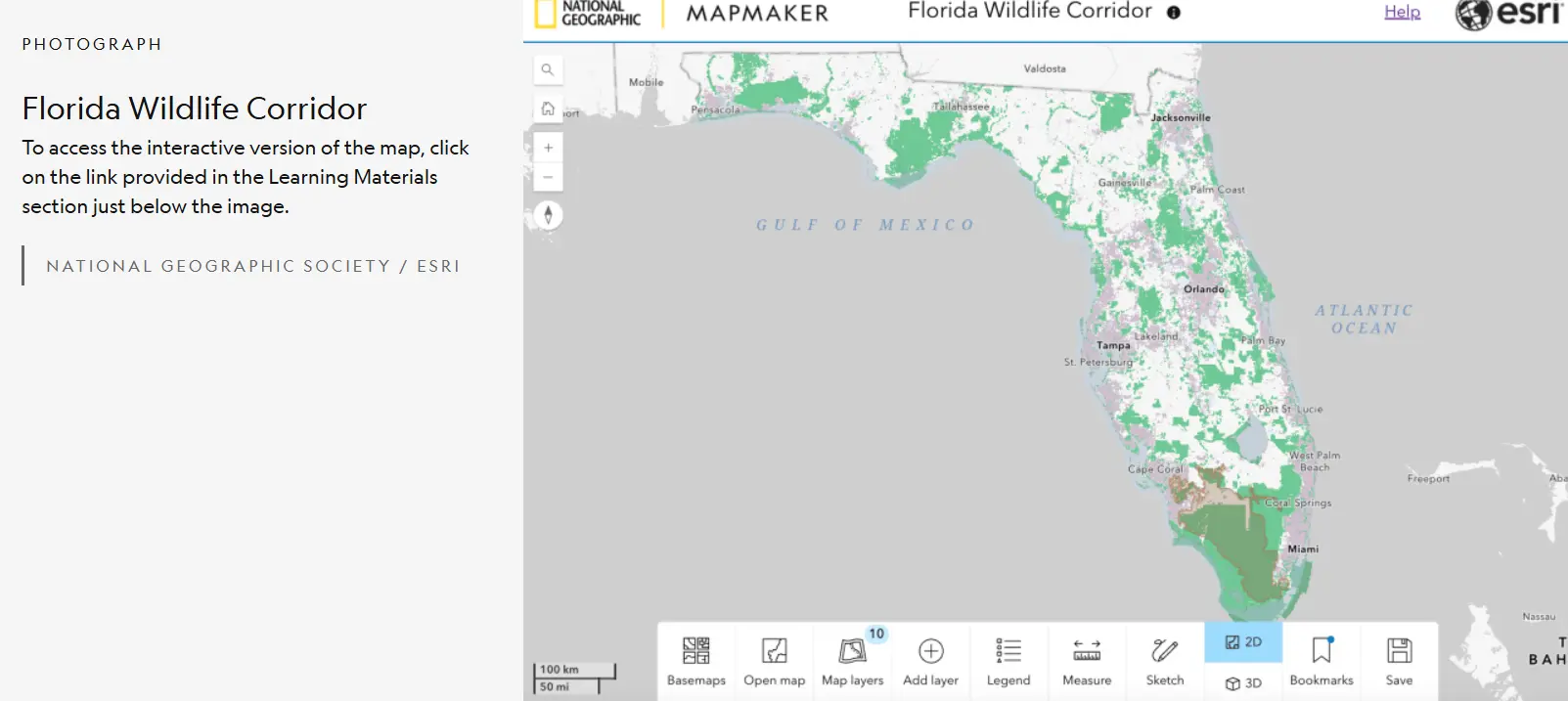
National Geographic Explorer Carlton Ward, Jr. is focused on conserving key corridors throughout the state of Florida that will enable panthers and other wildlife to thrive. This map illustrates a comprehensive picture of the relationship between developed areas and protected lands, telling the story of panthers’ experiences throughout the state.
“This map was created in conjunction with the National Geographic film, The Path of the Panther. It’s a fascinating way to explore the geography of human-wildlife interactions.” – Kate
8. Biodiversity
Biodiversity refers to the variety of living species on Earth, including plants, animals, bacteria and fungi. While Earth’s biodiversity is so rich that many species have yet to be discovered, many species are being threatened with extinction due to human activities, putting the Earth’s magnificent biodiversity at risk.
“This article explains a key concept for what National Geographic is all about; its revision represents our commitment to be better for our audience.” – Clint
“Love, Hate, & the Weather” is an immersive podcast showcasing stories from Paul Salopek’s walking partners, trusted guides local to each region of the 22,000 mile Out of Eden Walk. Turn up the sound to hear their stories about big issues like migration, climate change, and cultural traditions as well as the everyday topics that connect us all: conversations about the things we love, the things we hate, and what’s up with the weather.
“I really enjoyed this podcast series with Paul’s walking partners from China and India. It’s a beautiful and intimate look into communities that I knew little about before.” – Bayan
10. Penguins: A Conservation Legacy (Margot)
Pablo García Borboroglu, a National Geographic Explorer, was drawn to penguins during his childhood on the Argentine Patagonian coast, inspired by his grandmother’s stories. Learn how this fascination led him to spearhead a large-scale conservation effort and the establishment of the Global Penguin Society in 2009.
“This open educational resource (OER) is an excellent case study of how National Geographic Explorers are using geography and mapping tools to champion wildlife conservation efforts. The work of Pablo and his team offers both a success story and a call to action. Also, who doesn’t like learning more about penguins?” – Margot
Earth’s human footprint measures the relationship between the human consumption of resources and the number of resources the Earth can supply. Explore our planet and see what areas are most or least impacted.
“The lesser developed places may surprise users. Much of western China, vast stretches of Russia, and significant areas in the Americas.” – Tyson
12. Photo Ark: Protect Species
Explore articles, photographs, videos, and activities inspired by the National Geographic Photo Ark. Connect with animals, learn about species protection, and investigate ways you can take action to protect species.
“National Geographic Explorer and photographer Joel Sartore’s images are awe-inspiring. Consider this page a jumping off point from which learners can learn more about the motivation behind his work and ways to take action to protect species.” – Kate
13. Explorers at Work: Christine Wilkinson
National Geographic Explorer Christine Wilkinson is a conservation biologist, carnivore ecologist, and science communicator. She uses participatory methods, remote sensing and GIS analyses in conjunction with participatory mapping to understand landscape permeability for carnivores, the dynamics of livestock predation and perceived human-hyena conflict risk, and the intersection between human and carnivore resource needs in and around Lake Nakuru National Park, Kenya.
“Christine not only tells us about her amazing work, but also lets her magnetic personality shine here.” – Clint
13 Favorite Education Resources From National Geographic – National Geographic Education Blog