
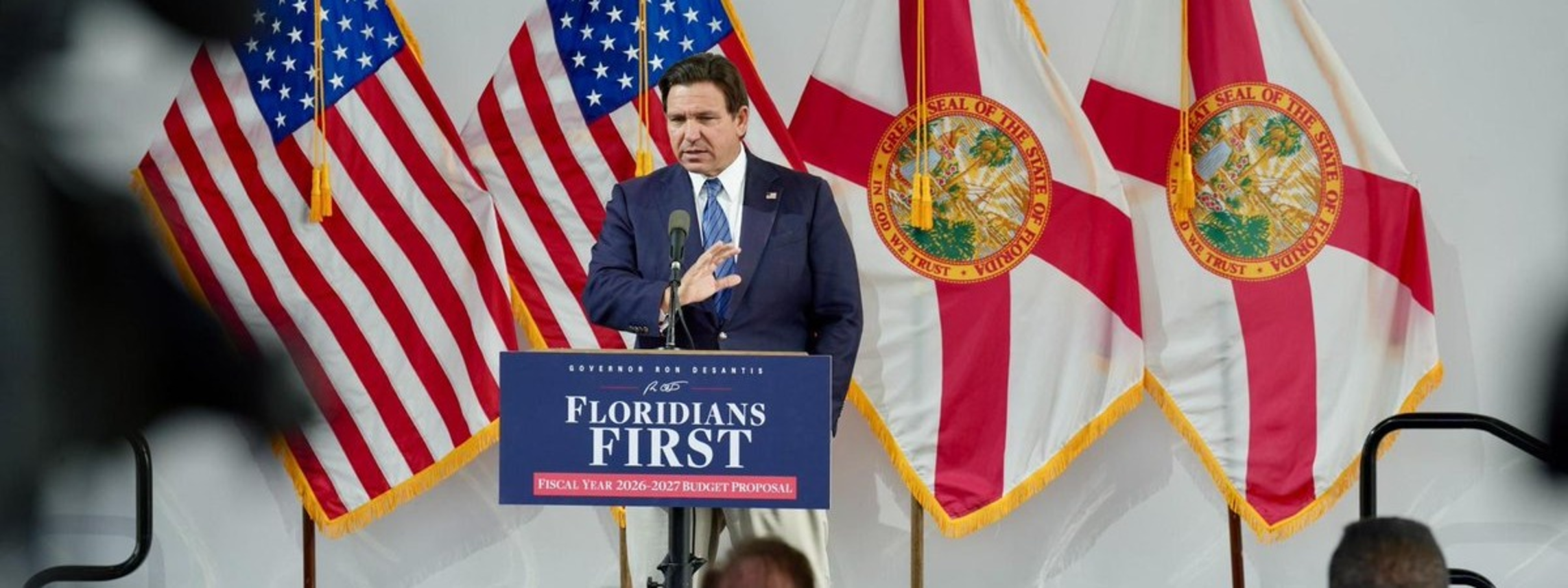
Governor Ron DeSantis Announces the Floridians First 2026-2027 Budget
ORLANDO, Fla.— Today, Governor Ron DeSantis announced his budget proposal for Fiscal Year (FY) 2026–27. The proposed Floridians First Budget totals $117.4 billion, including $16.75 billion in reserves and $250 million towards debt reduction. Under Governor DeSantis’ leadership, Florida has achieved record success, ranking #1 in education, net in-migration, entrepreneurship, and new business formations, with 3.8 million new businesses created since 2019, all while saving taxpayers money.
The Floridians First Budget continues Florida’s strong fiscal discipline with an additional $250 million in recurring accelerated debt paydown, putting the state on track to retire more than 50 percent of its tax-supported debt in FY 2026-27. During his two terms, the Budget Stabilization Fund has more than tripled, rising from $1.5 billion to the constitutional maximum of $5 billion and is once again fully funded with this year’s $118 million investment.
“Since I became governor, we have run budget surpluses, reduced the state’s legacy debt by more than 50%, and enacted record tax relief,” said Governor Ron DeSantis. “Today I announced the ‘Floridians First’ Budget, which will keep Florida on the course of fiscal responsibility and delivers on the priorities that have made Florida the greatest state in America.”
To read the budget highlights, click here.
To read the transmittal letter, click here.
To read the budget one pager, click here.
Protecting Florida’s Everglades and Water Quality & Supply
Florida’s natural resources are directly tied to the economic strength of the state and provide important defenses against natural disasters such as hurricanes. Florida has made record investments in protecting our natural resources and conserving the Florida way of life, and Governor DeSantis continues this commitment in the Floridians First Budget.
During Governor DeSantis’ first term as Governor, he signed record investments to protect Florida’s Everglades and support water quality, investing a record $3.3 billion. At the start of his second term, he called for a historic $3.5 billion investment over the next four years. The Governor’s Budget recommends $1.4 billion for Everglades restoration and water quality, bringing the total investment during the Governor’s second term to $6 billion, and bringing the investment during the Governor’s tenure to nearly $9.5 billion.
This includes continued investments in the Comprehensive Everglades Restoration Plan (CERP), the landmark dollar-for-dollar commitment between the state and the Federal government to restore America’s Everglades. This summer, during the 25th Anniversary year of CERP, we reached a historic agreement with the Trump Administration to accelerate CERP, including critical components of the Central Everglades Planning Project (CEPP) and EAA Reservoir. Of the $810 million dedicated to Everglades restoration, the budget allocates $681 million for CERP.
Within that amount $586 million of those funds directly supports CEPP, fully funding all remaining components of state-funded portions of the EAA Reservoir and CEPP South-Blue Shanty Flow-way. This investment ensures that the landmark of Everglades restoration is achieved and delivered five years ahead of schedule.
In addition, the budget provides $50 million for specific project components designed to achieve the greatest reductions in harmful discharges to the Caloosahatchee and St. Lucie Estuaries and $79 million for the Northern Everglades and Estuaries Protection Program.
Recognizing the importance of both the Everglades and South Florida’s water supply to the state’s economy, the Governor’s Budget calls for recurring funding to maintain completed everglades restoration projects. These funds are a direct result of the Governor’s debt repayment program which has reduced the need for debt service payments from the Land Acquisition Trust Fund (LATF).
To continue protecting Florida’s water quality and supply, the Governor is recommending $408 million for targeted water quality improvements to achieve significant, meaningful, and measurable nutrient reductions in key waterbodies. This includes:
- $150 million for the expanded Water Quality Improvement Grant Program for projects to construct, upgrade or expand wastewater facilities, including septic to sewer conversions, stormwater management projects, and agricultural nutrient reduction projects;
- $100 million for priority areas of the Indian River Lagoon and Biscayne Bay.
- $50 million to accelerate projects to meet scientific nutrient reduction goals, called Total Maximum Daily Loads
- $100 million for the Lower Kissimmee Basin Stormwater Treatment Area project to reduce the levels of phosphorus and nitrogen in the Kissimmee River prior to flowing into Lake Okeechobee.
Additional water quality investments include $50 million to restore Florida’s world-renowned springs and for land acquisition to protect springsheds as well as $65 million to improve water quality and combat the impacts of harmful algal blooms, including blue-green algae and red tide. The Floridians First Budget includes $60 million for the Alternative Water Supply Grant Program to help communities plan for and implement vital conservation, reuse and other alternative water supply projects.
Conserving Florida’s Natural Resources
To support conservation lands and to protect the great outdoors for generations of Floridians to enjoy, the Floridians First Budget invests $70 million in Florida’s State Parks for infrastructure improvements and resource management with the goal of maintaining Florida’s world class parks, which have won the National Gold Medal a record four times. The budget also includes more than $150 million to protect Florida’s conservation lands and waterways to ensure Florida’s prized properties are accessible for future generations of Florida families. This funding includes $115 million for the Florida Forever Program, the state’s blueprint for conserving Florida’s natural and recreation lands, including those located within the Florida Wildlife Corridor.
Florida is home to 1,300 miles of coastline which plays an important role in Florida’s economy and quality of life, attracting visitors from across the world and providing an invaluable defense against hurricanes. The Floridians First Budget includes $75 million in beach nourishment funding to bolster our shorelines.
The Floridians First Budget also prioritizes the protection of Florida’s working agricultural lands and family farms, providing an annual appropriation of $200 million to the Rural and Family Lands Protection Program to enter into perpetual conservation easements. In order to preserve Florida’s iconic citrus industry, the budget invests more than $19 million for citrus research and the Citrus Health Response Program. This includes $7 million for research and additional advertising by the Department of Citrus.
The Floridians First Budget also includes $25 million to restore Florida’s Oyster reefs in Apalachicola Bay. Over the last two decades, bay wide declines in oyster reef size from over 2,000 acres to less than 100 acres resulted in a reduction of oyster populations that led to the ongoing fishery closure, instituted in 2020. This project will provide for continued restoration in Apalachicola Bay in support of sustainable oyster reefs that protect and enhance the ecosystem services this natural resource provides to the public.
To further protect Florida’s rural areas and communities surrounded by Florida’s beautiful forests, the Governor’s Budget provides $4 million to support the replanting of trees and timber impacted by hurricanes and natural disasters, in addition to investing over $114 million in Florida’s efforts to effectively combat wildfires including equipment, and wildfire suppression activities, such as prescribed burning.
The budget includes more than $12 million for the care and management of manatees, including $3 million for the restoration of seagrass to support the increased habitat and forage for Florida’s state marine mammal.
Additionally, the Floridians First Budget includes $73 million in additional federal Community Development Block Grant funds for local hurricane recovery and hardening efforts throughout the state, including the Community Development Block Grant Disaster Recovery Program and the Community Development Block Grant Mitigation Program.
Read the full article: Governor Ron DeSantis Announces the Floridians First 2026-2027 Budget | Global Agriculture Online