
Attorney explains Deering Park development in Edgewater and New Smyrna Beach
The massive Deering Park project spans two cities and a massive track of central Florida land.
This has led to confusion about which part of the project applies to which city. For example, is only New Smyrna Beach potentially set to receive an industrial park?
Glenn D. Storch, who represents the project for Storch law Firm, spoke to clarify details about each element of Deering Park.
“I like to start with the history,” Mr. Storch said. “The land covers about 70,000 acres and most of it (almost 60,000 acres) has been owned by the family for more than 100 years, if you can believe it.”
The land was used for agriculture, primarily for growing pines, until, unfortunately, the mills closed.
“Generally, when land cannot be used for profitable agriculture, it is usually sold,” Mr. Storch said. “So, these many thousands of acres were subdivided into thousands of 10-, 20- and 25-acre lots that would have required thousands of septic tanks and wells and fencing of every lot – no wildlife corridors and no economic development. The property was approved to be sold in that way, with miles of dirt roads, but the family decided to do something new instead.”
Intent on clearing confusion about the project, Mr. Storch spoke directly about where each portion of Deering Park is underway or in planning.
•Deering Park North and Deering Park Center are in Edgewater and have begun construction.
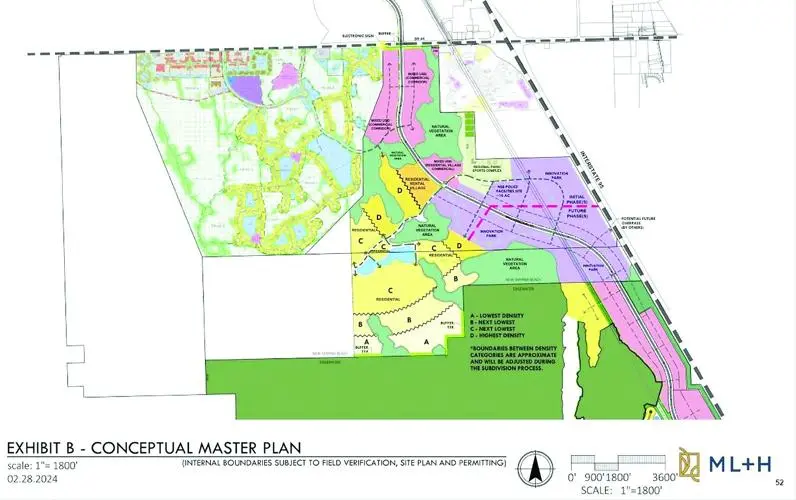
•Deering Park Innovation Center is a separate community planned in New Smyrna Beach.
Deering Park North is 5,187 acres with 6,600 housing units and 2.8 million square feet of office, industrial and commercial space. With 3,732 acres are set aside for conservation. This is a reduction in density and intensity from the former approved Restoration DRI.
The second Edgewater community is called Deering Park Center. This community is about 900 acres and has up to 1.5 million square feet of non-residential space. It is entitled for 1,362 housing units.
The two Edgewater communities are divided by Indian River Boulevard, which will be be extended west of Interstate 95 to the Williamson Boulevard right of way. Williamson will eventually stretch from Pioneer Trail (where it ends now) to Indian River Boulevard in Edgewater. It will be an alternative to I-95 from Edgewater to Ormond Beach.
“Our actual concept is that living in the Deering Park community will be like living in a park,” Mr. Storch said.
The Deering Park Stewardship District has been created to provide for infrastructure and maintenance within the 63,000 acres of the overall Deering Park planning area. The district already is building the Edgewater Wetland Park. The goal is to remove Edgewater reuse water currently permitted to be dumped into the Indian River Lagoon. This project will also enhance the aquifer.
Deering Park Innovation Center is a 1,618-acre mixed-use development planned to provide up to 6 million square feet of commercial and light industrial space with 2,150 residential units and 400 acres of natural vegetation.
“With the Deering Park Innovation Center,” Mr. Storch said, “we are planning to work with the city to create a regional stormwater management system that will provide a means to deal with the unprecedented rainfall that we have endured with Hurricanes Ian and Milton, and, at the same time, enhance and utilize wetlands ecosystems to reduce flooding in surrounding areas, and recharge the aquifer. It gives us a way for all of the communities to work together to prevent flooding.”
The overall Deering Park projects, across both cities and the county area, makes a coast-to-coast connection for the Florida Wildlife Corridor possible.
“Rather than breaking it into separate ranchettes,” Mr. Storch said, “they worked with the counties, environmental organizations like Audubon, and the state to cluster sustainable job creating development in the appropriate areas and create wildlife corridors on more than 46,000 acres with permanent conservation easements.”
Mr. Storch believes the project is not only good for the communities, but the family deserves thanks for the decisions made.
“I think we are so lucky to have a family willing to put effort into making something special,” Mr. Storch said. “It cost a fortune to do this the right way. I think we owe them a debt of gratitude.”