
The Pinellas Trail could be St. Pete's next Central Avenue
Developers and brokers say early leasing activity signals a shift toward treating the Pinellas Trail as a front-door retail address
The Pinellas Trail that runs through Dunedin’s quaint downtown couldn’t feel more different than the St. Petersburg portion of the trail.
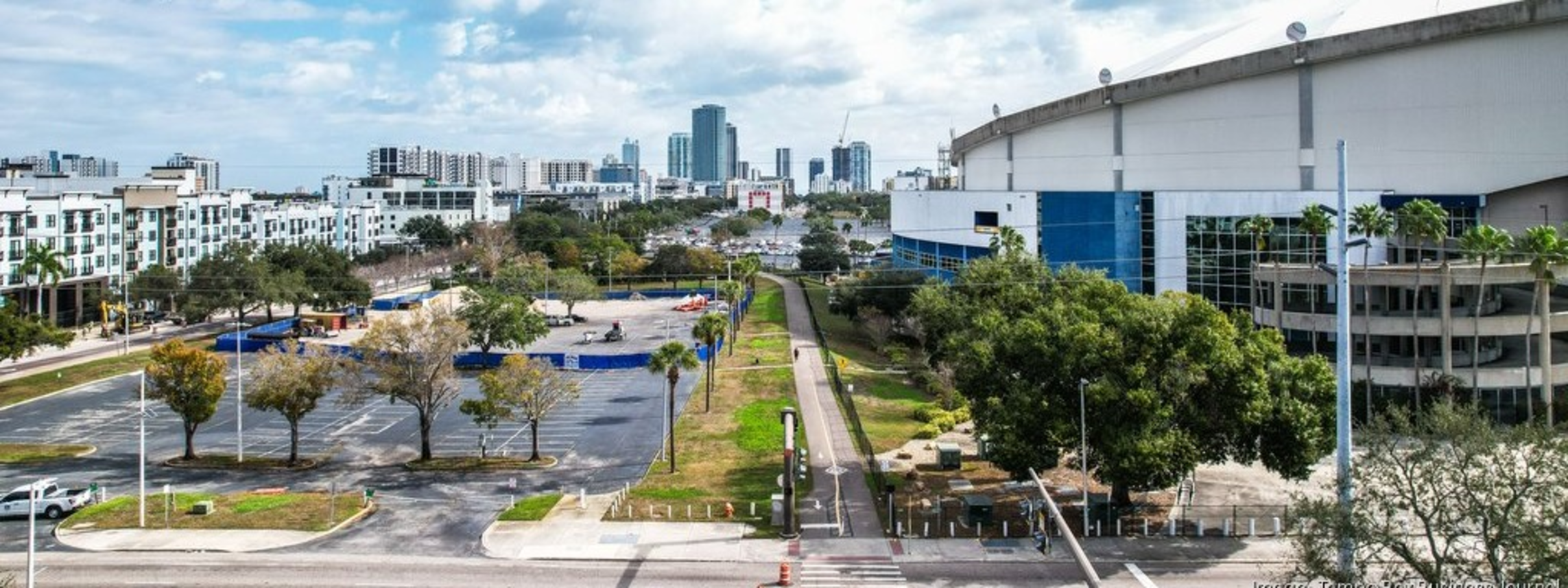
In Dunedin, the cacophony of the trail is part of downtown, as the steady rhythm of bicycle wheels and joggers’ footfalls mix with the clink of glasses and hum of conversation from nearby patios. In St. Pete, the same trail feels more like an alley, with parking lots and the backs of buildings lining the path, said John Barkett, broker-owner at Ascension Real Estate Partners and founder of Friends of Trails Crossing.
Barkett is one of the advocates working to make the trail a more vibrant destination in downtown St. Pete; he wants to make it a “civic front porch,” where people linger, versus the current landscape of sandy lots and wire fences. Trail-oriented development, like Barkett’s Trails Crossing park and apartment towers like Modera, is one part of the solution. Those sorts of developments are challenged by the zoning along the trail in parts of St. Pete, which designates prime real estate for industrial buildings rather than housing and storefronts that could activate it.
But real estate experts say the trail could become St. Petersburg’s next major growth corridor — even a second Central Avenue, which is known for its bars, boutiques and other local businesses.
“The trail is not a back-of-the-house amenity,” Barkett said. “It’s a front door economic engine.”
St. Pete officials explore flexible zoning around the trail
In St. Pete, much of the trail — especially through the Warehouse Arts district and west toward 34th Street — cuts through industrial-zoned land. That zoning limits trail-oriented redevelopment because it permits uses like warehouses, fabrication and employment, not apartments, cafes, breweries, bike shops or mixed-use projects that open onto the trail.
“When you introduce multifamily to an industrial area, it can start to inflate land values in a way that the arts community and other industrial users can no longer compete,” said Derek Kilborn, planning department director for the city of St. Pete. “So, it's really important to craft something that is unique to St. Petersburg and our experience in that district and that would protect or prevent some of those barriers of entry.”
For now, the overlay covers only a small portion of the Warehouse Arts district, leaving most of the land west of the SunRunner station under traditional industrial zoning. But city officials are discussing whether that model could be extended farther west along the trail as broader planning work — including the Central Avenue SunRunner overlay — moves forward.
“This 22nd Street is not the end,” Kilborn said, noting ongoing conversations about improving trail connections from the Warehouse Arts district toward the distillery site and beyond.
Zoning is pivotal to trail activation. In Dunedin, parcels along the trail are mostly zoned as “downtown core,” which is commercial-oriented, allowing for retail, offices, restaurants and residential units above ground-floor commercial space. But those parcels, like many along the former railroad, were once zoned for industrial.
The code requires businesses to front the trail, turning what would be back doors into front doors. Dunedin also took control of its section of the trail that runs through downtown and connected several properties to it. It also lit the trail and added amenities like benches, Dunedin Director of Economic and Housing Development Bob Ironsmith said.
Downtown St. Pete shows what the trail could be
Barkett is working to prove that trail-oriented development can thrive in St. Pete. He started by getting the entitlements for the first apartment tower fronting the Pinellas Trail, Modera, on what was a covered rail spur. Mill Creek Residential delivered the 20-story, 383-unit building, and its ground-floor retail — now owned by Miami-based Torose Equities — is being marketed for lease.
That tower was possible because the property was privately owned and lies within downtown zoning, which allows for the highest development intensity.
Gallery Haus, the 23-story tower breaking ground this year, also lies within the downtown zoning. Miami-based developers Black Salmon and LD&D plan to build 254 units along the trail.
The apartment tower will also include about 7,000 square feet of retail space, along with a bike room with direct trail access. The goal, Lopez said, is to keep the area lively and to position the trail as a front door rather than a back-of-house condition.
Farther west, projects like St. Pete Athletic, the Tibbets Lumber affordable housing site and the St. Petersburg Distillery show growing interest along the industrial stretch of the trail, but zoning still limits how much retail and housing can be built.
The distillery sits on the last 26 acres between the Warehouse Arts district and Gibbs High School with a quarter mile of trail frontage, distillery President Matt Armstrong said. Currently, only about 5% of distillery customers come in off the trail, something he’d love to see change as they plan development.
“The focus since 2019 is how do we embrace the trail? The mindset has been to look at it like a linear park,” Armstrong said. “Our goal as we develop this into something other than just industrial is to look at being open as many hours in the day as possible ... all those trail adjacent, trail accessory-related activities.”
Next corridor of growth
St. Pete’s growth continues to push west, as exemplified by Central Avenue. Local businesses grow up on Central Avenue, and they’re being priced out, said Lauren Campbell, principal, Archer Group Real Estate.
“Where are those creative trial-and-error retailers going to go? How are we going to keep some of that authenticity?” Campbell asked. “They can’t pay $60 per square foot. Where can they go?”
The answer, in Campbell’s view, is the Pinellas Trail. Central Avenue could continue to flourish west toward 34th Street, but the trail, if treated like a street, could serve as the city’s next corridor of growth.
“We think St. Pete is ready to have more than just Central Avenue, which means it’s really growing up in a good way,” she said.
Out-of-town investors are already betting on that future. Torose Equities, a Miami-based group, sold the Modera parcel to Mill Creek Residential and bought back the ground-floor retail, becoming one of the first landlords trying to lease space directly on the trail.
“We’ve always been kind of bullish, long-term viewers of the trail as a special kind of activation,” Torose founder Scott Sherman said. “We’re really the first new retail opening up on the Pinellas Trail, so we’re early.”
With 14,000 square feet of retail now for lease at Modera, Torose is targeting cafes, juice shops and other trail-oriented tenants — the kind of uses more commonly found on Central Avenue.
If zoning rules loosen in the Warehouse Arts district and west, developers and brokers say the Pinellas Trail could become St. Petersburg’s next growth spine, emulating the success on Central.
A hint of that momentum is visible along the trail as it passes Modera’s apartment tower and Vertical Ventures. The air shifts near Foodie Labs, where the smell of cooking drifts from its shared kitchens and event space, before the path veers toward art galleries and St. Pete Athletic, where the thwack of pickleballs welcomes pedestrians and cyclists. Activity is starting to brew even as vacant lots signal room for what could be next.
It’s not downtown Dunedin, to be sure. But that’s part of the opportunity: Like everything else in the Sunshine City, residents and officials will put their own spin on the trail to make it distinctly St. Pete.
Source: https://www.bizjournals.com/tampabay/news/2026/01/30/pinellas-trail-st-petersburg-growth.html?utm_source=st&utm_medium=en&utm_campaign=me&utm_content=TA&ana=e_TA_me&j=43835662&senddate=2026-01-30&utm_term=ep4&empos=p4