
Florida’s tribes today: preservation and perseverance
Through war and upheaval, Florida’s Indigenous tribes endured.
Today, that legacy lives on through the Seminole Tribe of Florida, the Miccosukee Tribe of Indians of Florida, and the Independents, whose ancestors survived colonial strife and found refuge in the wetlands of the Everglades and South Florida. The Independents are those people who chose not to join one of Florida’s two federally recognized tribes.
For Miccosukee leaders, that history remains crucial to the tribe’s identity.

William “Popeye” Osceola of the Miccosukee Business Council stands near tribal members’ homes outside what is now Alligator Alcatraz in Ochopee, eastern Collier County. -KELLY J FARRELL / FLORIDA WEEKLY
William J. “Popeye” Osceola, secretary of the Miccosukee Business Council, said the Miccosukee are a sovereign people whose identity was established before Europeans arrived.
“It predates the term Seminole,” he said. “Seminole is a coalition. Miccosukee chose its tradition.”
Like earlier tribes, the name Seminole likely derives from the Spanish word cimarrón, meaning “wild” or “runaway.” The first Seminoles migrated to Florida in the 1700s from Muscogee (Creek) communities in Georgia and Alabama, incorporating remnants of earlier societies like the Calusa and Tequesta.
The Miccosukee trace their ancestry to Hichiti-speaking groups that came to Florida in the 1700s. Though geographically linked with the Seminole, Miccosukee communities kept their own distinct language and identity.
But tribal identities were never as fixed as outsiders often believe.
“There is more fluidity between tribes or Native nations than people really conceptualize,” Osceola said. “There were vast trading networks and interactions between the hundreds of Native nations in this land.”
Efforts to remove Florida’s tribes culminated in the Seminole Wars, a series of conflicts between 1816 and 1858.
Osceola said his tribe views the wars not as separate events, but as a single prolonged struggle: “One long war in three acts.”
“The Seminole Wars were about trying to either destroy, displace or replace the people and who they perceive themselves to be,” he said. “That’s why we cling so hard to our identity.”
Osceola describes the Seminole identity as a wartime alliance formed under pressure.
“It was like these different groups came together, almost like the Allies did during World War II, to push back against this dominating force,” he said. “Some of those people that the non-Natives refer to as Seminoles decided to maintain that coalition because that is where this outside government was willing to meet them.”
It ended in a stalemate.
“It was the costliest war the American government ever waged against the Native peoples, and they didn’t win,” Osceola said. “They just gave up.”
Many Native people were killed. Others were forced west to states like Oklahoma. Some remaining tribes signed treaties – often at gunpoint.
To escape the conflict, Sam Jones – known as Abiaka, a medicine man, war leader and respected elder – led his people where the government wouldn’t follow.
“If we go further south into the swamp, it will protect and save us,” Osceola said of his ancestor’s decision. “And we found that to be true.”

- William “Popeye” Osceola and Michael Frank, an elder with the Miccosukee Tribe of Indians of Florida, visit a traditional Miccosukee cultural mound. -COURTESY PHOTO

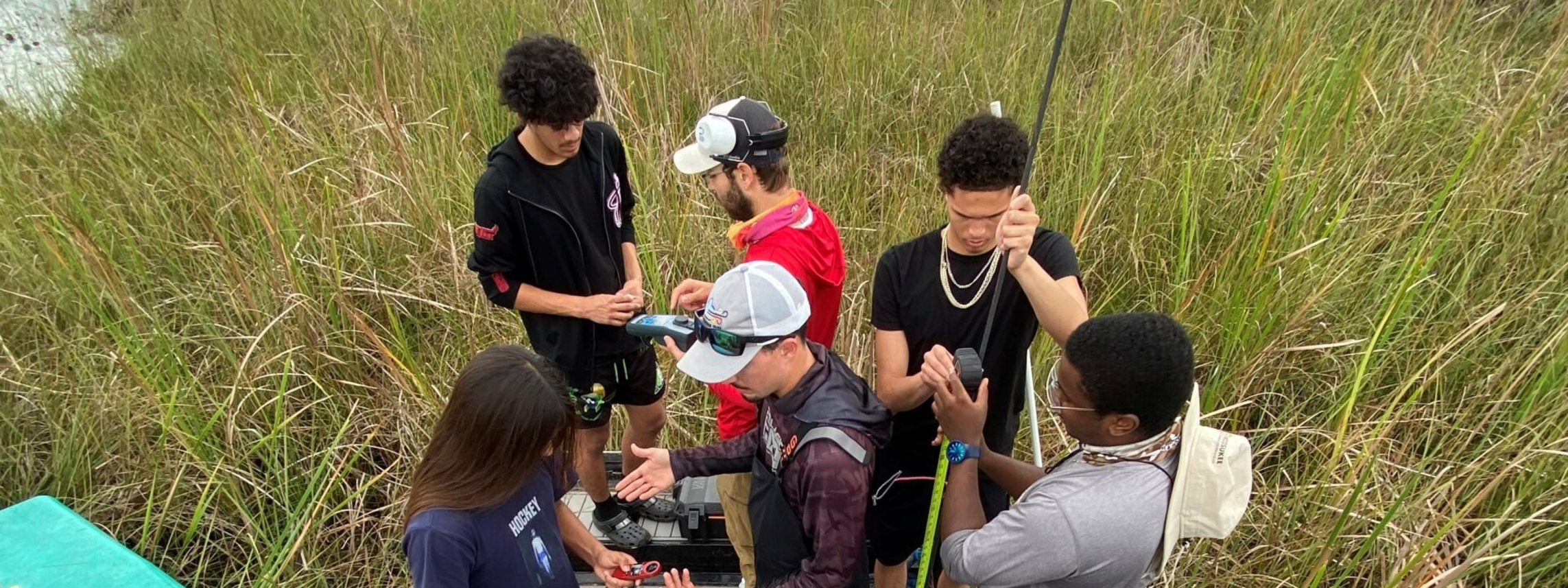
- Tribal members and volunteers collect water-quality samples in the Miccosukee Water Conservation Area. -MICCOSUKEE TRIBE / COURTESY PHOTO
Osceola called Jones “the Miccosukee Moses” who saved the tribes.
“That’s why we’re still here… we’re only here because of the refuge that it provided, culturally and spiritually.”
The tribes survived as federal pressure waned.
“They forgot about us because they’re busy fighting themselves,” Osceola said, referring to the Civil War era. “So, for us, we were in the Everglades, the land was providing, and we were left alone.”
Isolation couldn’t last. With development encroaching on their South Florida home, tribal leaders worried their culture could be erased.
In 1957, the Seminole Tribe of Florida gained federal recognition. The Miccosukee Tribe followed in 1962.
For the Miccosukee, identity, spirituality and survival are inseparable from the land.

William “Popeye” Osceola speaks to members of the Osher Lifelong Learning Institute and Tallahassee Historical Society about tribal history. -COURTESY PHOTO
“Our belief system is based off medicine that the land provides,” Osceola said. “If these medicine plants are in the land, that means we have a place on that land as well.”
The tribe’s constitution is one of only two in the world – the other being Bolivia – that mentions the environment.
“We have to conserve and develop our land and resources for future generations,” Osceola said. “Everything we do is to maintain the sanctity of the ecosystem around us.”
In August 2024, that commitment took form in a co-stewardship agreement with the National Park Service for Everglades National Park and Biscayne National Park.
In total, the tribe manages or shares management of more than 2.8 million acres, according to Edward Ornstein, the tribe’s deputy general counsel and embassy director.
The tribe expanded those efforts in 2025 by exploring stewardship along the Florida Wildlife Corridor, an 18-million-acre network of public and private lands stretching from the Florida Panhandle to the Everglades.
“We recognize we have no home if we don’t fight for it,” Osceola said. “If we didn’t have money, we’d still be fighting for it, because that’s what my ancestors were doing.”
Learning is essential to preservation. Before entering tribal leadership in 2021, Osceola taught language, culture and computer animation at the Miccosukee Indian School.
“Education is the ultimate avenue to upward mobility for any community,” he said.
But within the tribe, education extends far beyond formal schooling. His grandparents won a legal battle securing an exemption from compulsory education requirements, arguing that learning should not be limited to childhood.
“It’s understood that you’re supposed to be learning your whole life,” he said. “There’s always more to learn.

- William “Popeye” Osceola speaks at the inauguration of the Everglades to Gulf National Wildlife Refuge. -COURTESY PHOTO

- William Popeye Osceola of the Miccosukee Business Council speaks at Big Cypress National Preserve. -KELLY J FARRELL / FLORIDA WEEKLY
“All of life is about learning and passing on that knowledge and working together to not lose that knowledge.”
That heritage is scarred by trauma. Osceola spoke of stories passed down by ancestors: mothers smothering newborn infants so their cries would not alert soldiers.
“We deal with intergenerational trauma, because of the war times,” he said, adding that many tribal families were emotionally distant as a result.
He found a way to unlock his emotions through art. Before age 21, the only time he cried was while watching The Iron Giant.
He now lives just outside the reservation in the Miami-Dade area – in part to be closer to movie theaters.
“Animation and filmmaking are like empathy machines,” he said. “They allow you to learn about emotions, discover new ones that maybe you can’t recognize within yourself. One of the greatest things humanity has ever done is create these vehicles of expression – communication through art.”
In recent years, both the Seminole and Miccosukee tribes have spoken out on public policy, including opposition to development projects in the Everglades they consider sacred, such as the so-called “Alligator Alcatraz” immigrant detention center.
As a tribal leader, Osceola said he spends much of his time engaging with the public. He said more people should become involved in their communities, quoting one of his favorite shows, “The Simpsons.” “’They have the plant, but we have the power,’” he said.
“People don’t realize the public has more power than they think,” he said. “All you have to do is engage with your elected officials and show up at these meetings and make the voices heard.”