
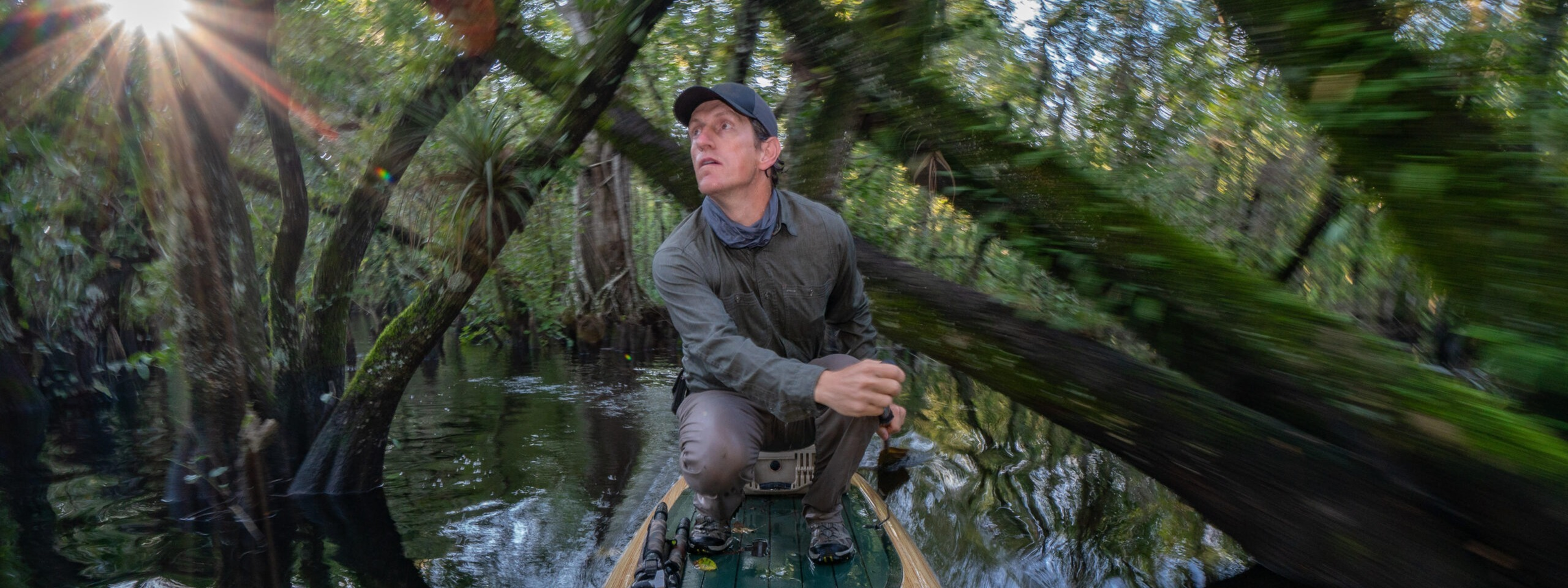
Carlton Ward Jr., National Geographic Explorer, photographer, 2026 Eliza Scidmore Award Recipient and founder of the Path of the Panther project, paddles to a camera trap site in the Fakahatchee Strand. -CARLTON WARD, JR. / NATIONAL GEOGRAPHICThe country is waking up to Florida’s Everglades on “Good Morning America” featuring National Geographic Photographer Carlton Ward, Jr. and Betty Osceola.
Ward and Osceola do it again—the duo, known for the film “Path of the Panther” and for bringing the Florida Wildlife Corridor to life—bring the importance of the Everglades and the critically endangered Florida Panther to a national audience once again. Ward’s awarding-winning photography and filmmaking, along with Osceola’s lifelong advocacy, make for a great honor to the Sunshine State and the nation, seen coast to coast.
National Geographic includes Florida Everglades as one of the “Seven Wonders of America.” ABC 7 and “Good Morning America” partnered for the show “America the Beautiful,” streaming on ABC7, Hulu and Disney+, and featuring the Everglades as one of those seven wonders in honor of America’s 250th anniversary.
“It’s a part of the country that the world needs to see,” says Robin Roberts, “Good Morning America” co-anchor.
‘Good Morning America’ in the Everglades
Roberts tells the story of the Everglades as one of the seven wonders by taking an airboat ride with Osceola, who owns and operates Buffalo Tiger Airboat Tours. Ward is on board to share his take.

Betty Osceola is seen on “Good Morning America,” featuring the Everglades, her tribe’s homeland, as one of America’s seven wonders, streaming now on Disney+. Here, she interviews for The Guardian. -KELLY J FARRELL / FLORIDA WEEKLY
Osceola is a member of the Panther Clan of the Miccosukee Tribe of Indians of Florida. She played an integral role with Ward, the National Geographic explorer and photographer, in “Path of the Panther,” a film that showed in the Naples International Film Festival, was produced by Ward, executive produced by Leonardo DiCaprio and won an Emmy for Outstanding Nature Documentary.
“It’s a magical place,” says Osceola in the opening of the Everglades’ segment of “America the Beautiful,” which aired live on July 4 in a 24-hour special episode of “Good Morning America” and continues to stream.
While many Americans show a love and appreciation for the land, what makes the Miccosukee unique, is that protection of the Everglades is written into their constitution. With that love of the land, comes great responsibility.
Everglades as one of seven wonders
“Why the Everglades?” asks Roberts. What makes the Everglades one of seven wonders?
“What you see are vistas as grand as the Grand Canyon or Yellowstone,” Ward replies. “It’s just hidden in plain sight.”
The Everglades, described by the Indigenous as the “river of grass”—later becoming the name of a book by Miami Herald journalist and Friends of the Everglades founder Marjory Stoneman Douglas—is the widest and slowest moving river in the world.
The Everglades is now half the size it once was and is still approximately 1.5 million acres spanning from Orlando and Lake Okeechobee area down to the Florida Bay. Covering about one third of the state, the Everglades is a unique meeting place of fresh and salt water with nine habitats and the largest thicket of mangroves in the Western Hemisphere, reports Kaitlin Menza, who wrote for National Geographic “7 Natural Wonders of America,” including the Everglades, also published on July 4.
Just about 30 miles from the apartments of Naples and Miami is this wonderland of the Everglades, Ward tells Menza.
The programming for the seven wonders and “America the Beautiful” spanned multiple networks, formats and platforms to fit the diversity of American audiences.
The other seven wonders featured are the Grand Canyon, Yellowstone National Park, Appalachian Mountains, Hawaii Volcanoes National Park, Niagara Falls, Redwood National and State Parks.
Everglades’ iconic panther
One of the first features of the Everglades that Roberts inquires about during her journey with Osceola and Ward are the species of animals and plants—of which there are at least 2,000 in the Everglades, she reports—and the endangered species among them.

- CARLTON WARD, JR. / NATIONAL GEOGRAPHIC

- A male panther leaps over a creek at Florida Panther National Wildlife Refuge in southwestern Florida. The rarely seen cats, which number only around 200, are reclaiming territory north of the Everglades, but their habitat is threatened by encroaching suburban sprawl. -CARLTON WARD, JR. / NATIONAL GEOGRAPHIC
The most iconic of which — and among the most critically endangered—is the Florida panther. There are between 120 and 200 panthers in Florida, according to estimates by Florida Fish and Wildlife Conservation Commission.
“Maybe we’ll see one today, the water is low enough,” says Osceola from the airboat as the trio prepare to journey through the river of grass. “You never know,” she adds, as they head toward tree islands where Osceola’s ancestors lived, safely escaping those invading the area at the time.
There, they see the chickee huts made of cypress trees and Osceola shares that the word “chickee” is a variation of the word “home” in her language.
In the Everglades, spanning east to west, Miami to Naples, are several endangered species in various stages of decline and recovery. The Florida Panther went from about 20 large felines remaining in 1995 to as many as 200 now. In part, that boost in population is due to the introduction of the Texas cougar.
Why Ward is part of telling this story

Carlton Ward Jr., National Geographic Explorer, photographer, 2026 Eliza Scidmore Award Recipient and founder of the Path of the Panther project, features the Everglades as one of the seven wonders of America, which aired live July 4 on “Good Morning America” and is streaming on Disney+. -CARLTON WARD, JR. / NATIONAL GEOGRAPHIC
“My work is rooted in a commitment to using photography as a vehicle for advocacy, especially when the connectivity of our natural world is at stake,” Ward says. “I am driven by a desire to reconnect the planet and, in doing so, reconnect people to nature. I have found that storytelling is often the missing catalyst to transform science into action, so to truly save these landscapes, we must go beyond documentation by visually defining the path for wildlife while influencing the public policies required to protect them.”
Ward’s recent award
Ward won National Geographic’s Eliza Scidmore award earlier this year. The award is named for writer and photographer Eliza Scidmore, the first woman elected to National Geographic Society’s board of trustees in 1892.
The award recognizes individuals whose immersive storytelling advances people’s understanding of environmental and conservation issues, with the ultimate goal of supporting people to make the best decisions for a healthier planet. Ward, 50, received this honor during the 50th annual National Geographic Storytellers Summit in February, held in Los Angeles, California.
The award was given in recognition of his engaging photography and ongoing conservation efforts with the Florida Wildlife Corridor, networks of land and water—including city scapes, farms and forests—to maintain species’ ability to migrate—and Wildpath, an organization founded by Ward to drive conservation outcomes, such as the 2021 Florida Wildlife Corridor Act, which passed unanimously to recognize an 18-million-acre network that requires collaborative planning to prevent habitat fragmentation to the point of animal extinction and loss of biodiversity.
“[Ward’s] masterful work proves something we’ve always known at the [National Geographic] Society: stories change the world,” said Jill Tiefenthaler, CEO of the National Geographic Society. “Through his lens, we see the beauty, struggle and resilience of nature with fresh urgency and care. [Ward] turns images into influence and stories into real, lasting change.”
Ward, who is somewhat soft spoken, is known for his ability to move people from awareness to appreciation and action, in Florida and beyond.
‘Path of the Panther’

A female panther steps through a barbed-wire fence, entering Audubon’s Corkscrew Swamp Sanctuary from an adjacent cattle ranch, with one of her kittens following, partially hidden behind her haunches. Now, Cameratta Companies proposes a new road through Corkscrew Swamp Sanctuary to serve Kingston, a massive master-planned development in Lee County. -CARLTON WARD, JR. / NATIONAL GEOGRAPHIC
One of the main lessons from Ward’s documentary, “Path of the Panther,” is the need for connectivity. Not only is conservation land needed, but lands need to be connected in such a way that the Florida Panther and other species can safely navigate that land and waters, moving from one area to another. Panther and black bear, among other species, need large territories to survive, due in part to competition within their species.
“Path of the Panther” directly influenced the passage of the Florida Wildlife Corridor Act in 2021, which allocated more than $2 billion dollars toward creating a contiguous wildlife corridor that extends from the southern tip of the peninsula all the way out to the panhandle of the Gulf. The act has saved more than 500,000 acres of wild Florida so far.
“Path of the Panther” was largely filmed in the western Everglades near Naples, specifically areas like the Florida Panther National Wildlife Refuge, which is home to some of the last remaining breeding population of the Florida panther, and was the location of this year’s somewhat famous panther birth. That cub was taken to Naples Zoo after its mother was not returning to the den.
Ongoing threats
Roberts asks Osceola and Ward what the greatest threats are to the Everglades.
“Well, the greatest threat that I see are development pressures. This is my people’s home and for the Miccosukee to be Miccosukee, we have to keep that deep connection here. And it’s continually having to remind people that in order for us to thrive here in Florida, we need to protect the Everglades itself,” says Osceola.
Ward answers the same question: “It needs to be protected, and it needs to be connected.”
“Urban development, draining – less than half of the initial Everglades system remains. Our coastlines are coming in. The seas are coming up. It’s ditched and dyked, and actually damned by roads that cut across it,” says Ward.

A neighborhood near Orlando cuts into historic panther habitat. New developments currently underway in eastern Lee and Collier counties are doing the same. Florida, USA. -CARLTON WARD, JR. / NATIONAL GEOGRAPHIC
Wildlife Corridor, connectivity and a path forward
“Path of the Panther” made way for the Wildlife Corridor and to Ward’s current focus—on Florida’s Gulf. Tracking animals, such as sharks, are no easier in the water, than they were on land, he says.
Much the way tracking panthers led to a better understanding of the importance of connecting the land, Ward’s documentation of how sharks travel has shown how important the Wildlife Corridor is to the health of the Gulf as well.
Migration of animals—whether on land or in water—is indicating which human activities need to halt, change, shift or change location—affecting not just science and scientists, but ultimately, politicians and policy. In this way, art and entertainment can change the world, for good.

- An Ogeechee tupelo spreads its branches over the tannic waters of the Suwannee River in North Florida, just south of Georgia’s Okefenokee Swamp. -CARLTON WARD, JR. / NATIONAL GEOGRAPHIC

- An Ogeechee tupelo spreads its branches over the tannic waters of the Suwannee River in North Florida. -CARLTON WARD, JR. / NATIONAL GEOGRAPHIC
“I feel so much hope with the Florida Wildlife Corridor Act. It’s a piece of legislation the rest of the country could look to,” Ward says.
The way the panther moves across the landscape shows us what we need to do.
“A panther has a home range of 200 square miles. There are very few places where you can protect that kind of territory without having all the pieces of the puzzle working together as a bigger whole,” Ward says.
Part of the connectivity is helping Florida to maintain its farms and ranches, including the cattle ranches of the past 500 years. They serve a role in cleaning water and providing spaces for animals to migrate away from dense development and traffic, Ward explains.
“You can build a concrete reservoir with a filter that may or may not work 20 years from now or you can keep this open green space that can filter and clean that water on its way down to the [Everglades] National Park,” Ward shares with Roberts in the making of “America the Beautiful.”
“That’s what the Everglades needs. It needs to be reconnected. It needs us to be reconnected,” Ward says.
“Because the decision makers decide the fate of this place. Yes, it’s Betty [Osceola] fighting for it here, but it’s people in Tallahassee and Washington, D.C. making decisions that they need to be reconnected to the importance and the presence of this place for the future,” Ward says.
“Whether it’s the flow of water or the flow of wildlife, everyone is on the same team, reminding us that the health of the Everglades is the health of us all.”
In The KNOW:

A camera trap on Green Glades West Ranch, adjacent to Big Cypress National Preserve, shows the transition from wet season to dry season at the base of a 500-year-old cypress tree. Like panthers, Florida black bears have vast home ranges and depend on a network of connected habitats to survive. -CARLTON WARD, JR. / NATIONAL GEOGRAPHIC
Watch “America the Beautiful” to see the Everglades as one of “7 Natural Wonders of America”
- Streaming on Hulu and Disney+
- Visit DisneyPlus.com
- Also find there the Emmy-award winning “Path of the Panther”
Panther news, facts and stats
• A panther kitten was born at the Florida Panther National Wildlife Refuge in eastern Collier County early in 2026, around the time Carlton Ward was winning National Geographic’s Eliza Scidmore award for his work on “Path of the Panther” and the Wildlife Corridor. • By March, the kitten was rescued and transported to Naples Zoo when the mother was not returning to the den.Check back to Florida Weekly for updates on this kitten named Peppercorn.
• Meanwhile, development of nearby Rural Lands West, the 10,264-acre development in prime panther habitat, remains underway by Tarpon Blue, the Punta Gorda-based conglomerate led by CEO Ken Smith that acquired Naples-based Collier Enterprises.
• Collier County does not publicly release all exact panther births due to the species’ endangered status. Instead, biologists at the Florida Fish and Wildlife Conservation Commission document litters by tracking the GPS data of radio-collared females.
• Panther sightings are tracked and eported on myfwc.com.
• Panthers have been endangered since 1967 with their breeding range restricted to Southwest Florida, south of the Caloosahatchee River.
• A pregnant female panther was seen on trail cams in Corkscrew Swamp Sanctuary in 2026.
• Panther litters are often one or two kittens after a three-month gestation.
• Since January, there have been nine panther deaths through June, including by vehicle crash along Collier Boulevard, with Collier County being the epicenter of the crisis. On July 1, a panther was killed in a vehicle strike in Lee County on Corkscrew Road.
• FWC documented several litters in the region throughout the year, confirming the area in and around Corkscrew Regional Ecosystem Watershed remains a critical habitat for the endangered species
• The three births in 2025 recorded by FWC compared to 18 deaths over the same time period. Though not in the FWC online records of births, FWC documented several litters in the Collier County area, including in and around Corkscrew Regional Ecosystem Watershed and Audubon Corkscrew Swamp Sanctuary and Pepper Ranch in 2025. Litters reported on myfwc.com do not represent all kittens born each year. Instead, they represent the kittens born to adult female panthers wearing radio collars documented by FWC.
• FWC’s panther team has monitored approximately 550 kittens over approximately 35 years
• Other significant developments planned in prime panther habitat in Collier and Lee counties include expansion of Ave Maria; Kingston in Estero with a recent proposal by Cameratta Companies to develop a road through Corkscrew Swamp Sanctuary to serve the 10,000 homes planned there; and Bellmar in eastern Collier County, among others.

- Camera traps targeting panthers provide an exciting look at some of the other species that share the same trails. Here, on a flooded trail through a pond apple and pop ash swamp in Florida Panther National Wildlife Refuge, wading birds trigger the camera. -CARLTON WARD, JR. / NATIONAL GEOGRAPHIC

- Like many of Florida’s springs, the eelgrass and other native vegetation at Manatee Springs has been overgrown and displaced by toxic green algae, seen ensconcing a manatee searching for food as observed from above. The proliferation of algae in recent years is attributed to increased pollution in springsheds and over pumping of the aquifer that has reduced spring flows. -CARLTON WARD, JR. / NATIONAL GEOGRAPHIC