
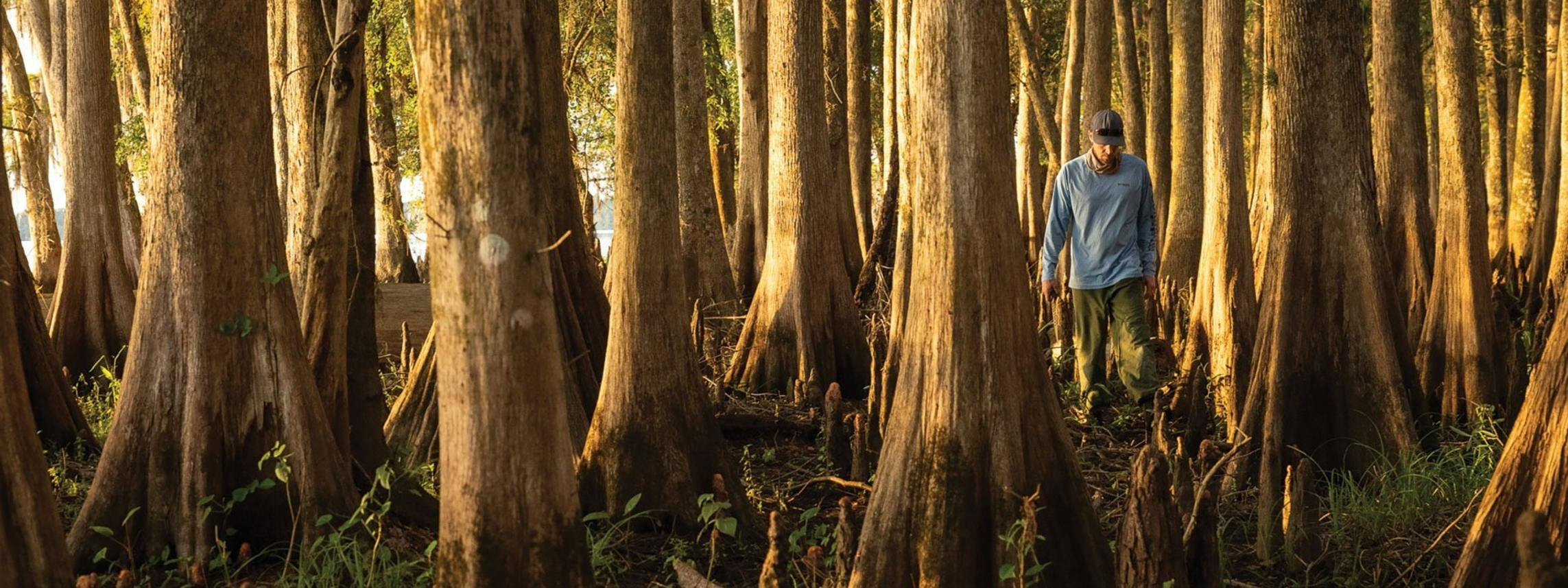
The Everglades Gets a New Story on Film
Independent filmmakers look beyond familiar Everglades mythology to uncover its people, history, wildlife and lesser-known stories.
here are landscapes that reveal themselves at once, and landscapes that must be learned by attrition. The Everglades belongs to the latter. It arrives in flashes and trespasses: in the deep amber-green evening after a storm, when frogs begin their racket so suddenly the dark seems to pulse, and an alligator stops broadside across a marl track, as if to remind the human world whose terms prevail here.
For generations, filmmakers treated the swamp as spectacle or menace: too flat, too green, too wet, too full of reptiles and rumor. It appeared as a backdrop for lawlessness, ecological warning and tourist awe. Missing from many of those visions was contact, the smell of mangrove mud at low tide, the way fear and fascination travel together in the body. The land had little texture and the people no faces.
A new wave of Everglades documentarians begins from a different premise. Across seven recently released independent films, from The Book of George to River of Grass, filmmakers differ in style and scope but share a refusal to use the swamp as mere background. They enter with questions and let the place answer back, dismantling inherited ideas about the land, who belongs there and what it asks of us.

Courtesy Danny Schmidt
George McKenzie, Jr. left Brooklyn’s city streets to photograph panthers and other Everglades wildlife. The subject of The Book of George, a new documentary by Danny Schmidt, he aims to democratize conservation storytelling and empower minority children to see themselves in wild spaces.
The Book of George follows George McKenzie Jr. When he arrived in this wilderness in 2021, he carried the rigid map of a 1990s Bed-Stuy childhood. A world of concrete and street violence had decided long before his birth where he belonged and where he did not. “The narrative we’re handed is that Black men belong under city lights, on asphalt or inside a system,” George says. “Nobody tells you that your ancestors knew the woods, or that your skin looks like the dark soil under the cypress trees.”
In The Book of George, director Danny Schmidt captures George’s transition from the streets of New York City to becoming an acclaimed photographer for National Geographic.
One afternoon, while working as a camera trap technician on conservation photographer Carlton Ward, Jr.’s award-winning Path of the Panther documentary, George was standing on an aluminum ladder planted deep in the black muck of a cypress strand when a bull alligator bellowed beneath him, hidden under a blanket of duckweed. For an instant, his mind returned to Brooklyn, where he’d spent the last autumn photographing pigeons perched on rusted fire escapes, pecking through broken glass and spilled sugar. George had come from a place where wildlife adapted to human architecture. Here, the alligator was the architecture. “I felt out of place because I was trying to read a wild landscape using a concrete alphabet,” he recalls.

Courtesy Wildpath/Carlton Ward, Jr.
Capturing the Everglades takes many hands, from film crew techs to expert guides. For The Little Brown Bird— a documentary following the native grasshopper sparrow from Carlton Ward, Jr.’s production company, Wildpath—director KT Bryden worked with biologist Fabiola Baeza-Tarin and a host of farmers, ranchers and fishermen.
Today, George mentors students in rural Florida, working to make the outdoors accessible to young people who rarely see themselves reflected in conservation stories. “The wild belongs to all of us,” he says.
The swamp is filled with stories like this, where people come with one idea and leave carrying another. Some among this new generation of filmmakers start with the material Florida loves to mythologize—from pot-running to blackwater and renegade snake hunters—then deepen the plot, replacing caricature with complexity.

Courtesy Wildpath/Carlton Ward, Jr.
Picture the back of a pickup truck edging through the Everglades at 5 miles an hour, until 2 a.m. Darkness gathers at the roadside in dense walls. A headlamp skims palmetto brush and moonlit ditch water. Mosquitoes lift in pale clouds. Every passenger stares so hard into the brush that vision begins to betray itself. A branch becomes a snake. A loop of vine flashes white, then vanishes. This is the world Xander Robin stepped into when he joined the Florida Fish & Wildlife Commission’s Florida Python Challenge, an invasive Burmese python removal contest taking place over 10 days in July across the Everglades. “The walls still seemed to move when I got back to bed,” Xander says.
From a distance, his film, The Python Hunt, could look like one more round in the “Florida man” oeuvre, built from menace and weirdness. But up close—in trucks, motels and parking lots lit by gas-station fluorescents—the story finds people trying, however clumsily, to make themselves useful in a damaged landscape.

Photography by Mac Stone
A rising crop of filmmakers is working to capture the Everglades’ sprawling ecosystem—from mangrove forests to Big Cypress National Preserve—reframing it from a place long defined by mystery and menace to one of raw beauty and ecological wonder worth conserving.
During the 2023 competition, Xander and his crew followed about a dozen of the 1,000-plus participants. They expected professional hunters and trucks full of unspooled muscle, a bulk of invasive, serpentine predators steadily subtracted from the marsh. Instead, he found accountants, retirees and casual adventurers, many of whom spent more than a week searching without ever seeing a snake. “What I really found was a world where people are trying to matter, trying to help and trying to understand something that will never be fully tamed,” he says.
Cars break down. Flashlights fail. One hunter arrives dressed as an imagined Florida wrangler in a hat, boots and snake gaiters. By the second day, he was still just himself—only sweatier, more exhausted and stripped of the fantasy. “The place takes the costume first,” Xander says.

Photography by Mac Stone
Mac Stone’s The Everglades: Beneath the Surface traces one of the world’s largest animal migrations.
None of these stories is told from afar. Each began with gaining access to a place that rarely reveals itself. With a May debut at the Fort Myers Film Festival, Outlaws of the Everglades started with director Rob Hoovis boating into a hidden cove. Two men stand up and ask: “What are you doing here? What are your intentions?”
Before pressing record, the Fort Myers filmmaker spent more than a year gaining the trust of people who had spent decades avoiding cameras, a community tired of being mined by outsiders and flattened into folklore.

Photography by Mac Stone
When national park restrictions on hunting and commercial fishing ramped up in the 1970s, Everglades families were stripped of their livelihoods. Some fishermen turned to smuggling, seeing it less as a moral choice than what they felt they had to do to support their families along a coast that no longer had room for the life they had inherited.
In the early ’80s, headlines burst with Operation Everglades, a federal sweep targeting marijuana-smuggling. Roughly 250 were arrested, which accounted for 80% of the adult men in Everglades City. “Hollywood and the tabloids love to treat the Everglades like a cartoon backdrop for renegades and cheap thrills,” Rob says. “We didn’t want to make that movie.”

Photography by Erica Arvizu
For Patchwork Wild: Stitching the Last Strands, Page Buono followed four trekkers from Picayune Strand State Forest to the Caloosahatchee River, highlighting relationships between natural habitats, working lands and development.
Rob and producer Brian Holaway, a Captiva Island captain, initially planned to interview seventh-generation fisherman Kent Daniels and other former smugglers. As reporting continued, they broadened the lens to include journalists, law enforcement, and the mothers and wives who held the community together after the raids. “If you only talk to the men who were out on the boats, you’re only getting half the story, the half that easily slips into outlaw mythology,” Rob says.
Each film takes its own approach to the Everglades. National Geographic photographer Mac Stone has spent much of his career searching for the swamp’s less familiar moments, the images that stop people long enough to reconsider what they think they know. In The Everglades: Beneath the Surface, Mac’s 6-minute short for the Everglades Foundation, the camera follows him from a helicopter as he moves from mangrove forests to coral reef dives to remote sloughs, revealing the patience and persistence behind photographs that make the most gnarled or remote stretches feel wondrous and intimate.

Courtesy Carlton Ward,Jr., Mac Stone, Danny Schmidt, Sasha Wortzel
One sequence tracks Mac’s weeks-long tarpon pursuit, captured from below the surface, exploding through the annual fall mullet run—a million-fish migration racing through the Atlantic surf, largely unnoticed by Florida’s city dwellers. Trip after trip comes up empty. The weather turns, the water clouds, sharks appear suddenly. “Inside a school of mullet, the body loses orientation,” Mac says. Just as he’s ready to give up, the conditions align.
The resulting image captured the chaos in a single frame, but film offered time and the drama of seeing it all unfold. Mac knows that facts alone rarely change allegiances. “What pulls [viewers] in is usually a human figure trying, failing, trying again,” Mac says.
When The Book of George premiered last fall in Tampa, it was presented alongside two other shorts at a film screening by Wildpath, Carlton’s conservation storytelling platform. Together, the films trace the connections that define the Florida Wildlife Corridor, an 18-million-acre mosaic of wild and working lands that protects migration routes for endangered species. In the 22-minute Patchwork Wild: Stitching the Last Strands by Page Buono, four trekkers paddle, hike and bike from Picayune Strand State Forest to the Caloosahatchee River. They cross private cattle ranches, highways and protected forests to see the fruits of decades of conservation work—and what’s at stake within the 8 million acres that remain at risk amid South Florida’s rapid urbanization.

Photography by Rob Hoovis
With insights from Miami Herald photojournalist Tim Chapman, Outlaws of the Everglades producer Brian Holaway dove into the plight of fishermen who turned to drug smuggling after the federal hunting and fishing restrictions in the ‘70s and ‘80s. The film won Fort Myers Film Festival’s Best Documentary.
The Little Brown Bird narrows the focus to the Florida grasshopper sparrow, North America’s most endangered songbird. In biologist Fabiola Baeza-Tarin’s hand, a sparrow is hardly more substantial than a dry leaf. Heart racing, tiny claws flexing, eyes bright as a pinhead, it must be held firmly enough to protect and lightly enough to survive the touch. The camera catches fingers parting feathers, measuring a wing and checking a nest woven low in the grass at Avon Park Air Force Range, an active bombing range and a vital recovery site for the bird, with 106,000 acres of the dry prairie habitat.
As an indicator species, the sparrow reflects the health of the entire system. The wide grasslands, which depend on it, also capture rainfall before it flows south, replenish aquifers and keep water moving cleanly through the Everglades. The short centers on the unlikely alliances and repetition required to keep one small life inside the human field of concern. “Conservation doesn’t happen in silos,” says KT Bryden, Wildpath’s executive producer and film director.

Photography by Danny Schmidt
Across these films, the Everglades eme-rges not as a setting but as a voice speaking its own ancient, urgent language. Sanibel Island native Sasha Wortzel was living in New York City in 2017 when she took an artist residency at Everglades National Park. It was weeks after Hurricane Irma spawned widespread fish kills and toxic algal blooms. The experience sent her back to Marjory Stoneman Douglas’ 1947 book, The Everglades: River of Grass, sparking a years-long documentary project to interrogate our responsibility to the imperiled watershed.
The essay film moves back and forth between Marjory’s words and present-day Florida. A passage from the book introduces an idea or place, then the film cuts to the location or brings in the voice of a scientist, crabber or Indigenous elder who embodies, complicates or challenges the prose. In one scene, Miccosukee educator and Panther clan member Betty Osceola navigates her airboat through a dense cypress canopy teeming with wading birds and glassy-eyed alligators, explaining to the camera: “Water has life. It has memory.” She then leads Sasha on a multi-day prayer walk through the shallow, slow-moving watershed to protest federal infrastructure projects built atop Indigenous lands. “I wanted to treat the Everglades as a character, as a place with subjectivity,” Sasha says.

Courtesy Sasha Wortzel
Sanibel native documentarian Sasha Wortzel’s River of Grass reimagines Marjory Stoneman Douglas’ 1947 book of the same name, juxtaposing the author’s words against the lived experience of figures like Miccosukee tribe leader Betty Osceola.
Five years into production, Hurricane Ian barreled through Sasha’s hometown, prompting her to weave in surveillance footage of the storm and her own voice. The shift reframed the documentary through the grief of someone watching a place she loved change in real time. The questions she carried into the project grew larger: Why is the water sick? What does it mean to belong to a place in crisis? How do you tell the story of a landscape that has shaped generations of people, yet is so often reduced to either postcard scenery or environmental catastrophe? Sasha does not force the questions into clean answers; instead, she lets them settle over the audience.
The swamp giveth and the swamp taketh away. It was a common refrain among the filmmakers. Historically, that meant flood, drought, fever, storm—the natural cycles that inspired human schemes. Some try to discipline what will not submit, to implement water diversion in an effort to control the very nature of nature itself.
These films, each in a different register, overturn that inheritance. What the Everglades takes, they suggest, is often what a person did not need in the first place—vanity, false mastery, the small and inward habit of imagining human life apart from the life that sustains it. It is the most human of stories in the wildest of places.