
Stitching Florida’s Wild Future
By Matea Denisen | Coastal Breeze News
On Wednesday, September 10, the Florida Wildlife Corridor Foundation (FWCF) convened roughly 80 stakeholders at North Collier Regional Park for a “Mind the Gaps” workshop aimed at stitching fragile wildlife connections across Collier, Lee, and Hendry counties. The day closed with a special screening of FWCF’s new expedition short, Patchwork Wild: Stitching the Last Strands, followed by a panel discussion.
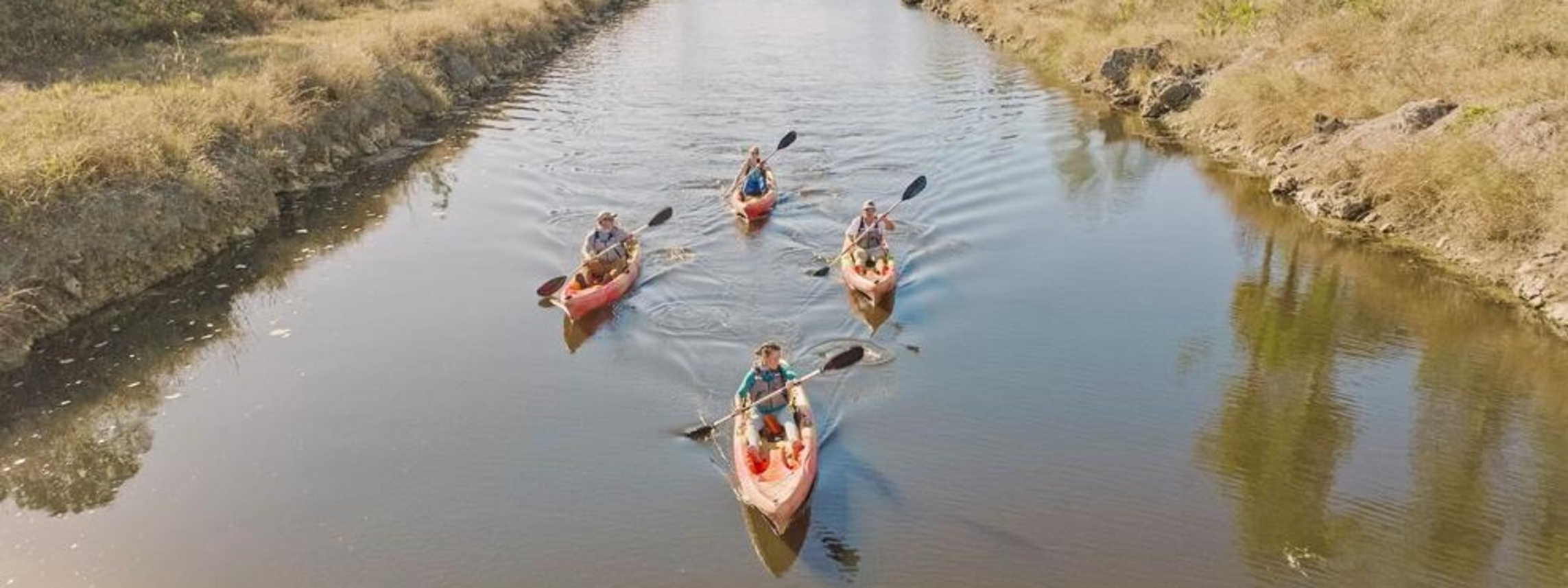
The documentary followed four trekkers on a week-long expedition through strands of cypress and shallow sloughs sparsed across Collier County. Filmed almost a year ago to date, the expedition highlights working lands and their vital role as connections between the protected wilderness throughout Southwest Florida.
Among the trekkers are Keaton Beal, a seventh-generation Floridian; Em Kless, a native Neapolitan and Interpretation Supervisor at Naples Botanical Garden; Laura Foht, mother, teacher, and naturalist; and their trek leader, Ryan Young, the owner of Rising Tide Explorers. To read more about the expedition, visit https://www.coastalbreezenews.com/news/the-florida-wildlife-corridor/article_fc37a0b0-b7db-11ef-9293-3b71657ac266.html.
The Patchwork Wild short film will be publicly screened in Collier County at the Naples Zoo on October 28 and at the Rookery Bay Environmental Learning Center on December 2.
FWCF Director of Conservation Allyn Childress said Southwest Florida was chosen because it’s a “case study” where development pressure, changing agriculture, and narrow connectors converge. “We’re trying to keep connections thriving, and that’s why we’re here today,” she said.
Panelist Ryan Young spent the day mapping gap areas with participants. He recognized the workshop as a chance to bring fresh insights back to thousands of visitors his guides meet each year. “We get that rare opportunity to be in front of people every single day,” Young said. “If we can explain why these places matter, and what people can do to help, the impact multiplies.”
Young also pointed to overdevelopment as a barrier to building wildlife connection with their guests, “the more development we have, and the more these areas get cut off, the less wildlife we'll be able to see and get people to experience out there.”
Audubon Western Everglades policy director Brad Cornell underscored the importance of working lands to remedy connection for both people and wildlife. “We cannot recover the Florida panther if we do not look at the role that private lands play,” he said. He stressed that conversing with the public and officials on what is mutually beneficial is key in strategizing the use of private lands. “The public has an interest in seeing its water protected and the wildlife continue. Corkscrew Swamp Sanctuary depends on the people who come walk its boardwalk every year; they're not going to come if there are no trees, if the wildlife is missing, and the birds are gone. So, there's an economic imperative too.”
Childress echoed Cornell’s sentiment, “I heard some great conversations between entities that might not always be in the same room and space together. That's the magic of this workshop.”
Among connection and collaboration, at the heart of the Florida Wildlife Corridor Foundation lies storytelling. Young reflected on his career in environmental education, highlighting the role that telling stories played in both informal and formal settings. “When they return from a tour for the first time, it looks entirely different to them.” He weaves together science and scenic views to not only teach guests about the importance of Southwest Florida’s ecosystems but how they fit into Florida’s narrative, creating a lasting sense of place. “If you're able to communicate in a way that really relates to them, whether they have any background or connection or have never seen the place before, this is education through storytelling,” Young added.
Overall, the Florida Wildlife Corridor is about safeguarding communities, animals and humans. Cornell explained that a connected corridor provides protection against wildfire, drought, flooding, and storms. “Having water resources, habitat, and wildlife that are still thriving is a sign of resilience,” he said, noting conservation projects like CREW Land and Water Trust. He stressed the significance of pushing water management districts and DEP to develop resilience plans that go beyond the coast, recognizing that protecting land and water today is a “multi-generational commitment” to Florida’s future.
For FWCF leaders, the workshop was not only about technical solutions but about building momentum. CEO Mallory Dimmitt closed the evening by thanking participants for their time and collaboration. “I’m inspired every time we screen a film, but more importantly, when we bring people together to have this conversation,” she said. “Planning Florida’s future is essential and none of us could do it without the collaboration from each of us.”
Stitching Florida’s Wild Future | Events | coastalbreezenews.com