
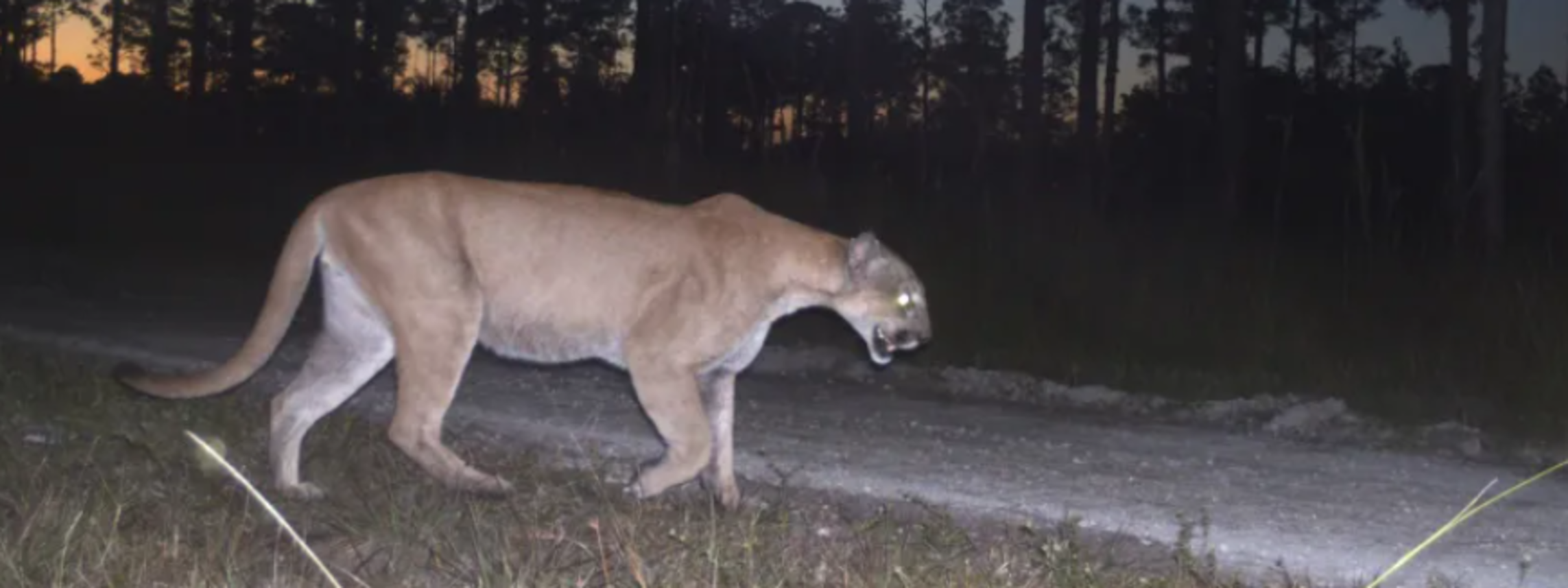
Yet another dead Florida panther — this one, crucially, was expanding its range north
By Bill Kearney | South Florida Sun Sentinel
The Florida Fish and Wildlife Conservation Commission has found yet another endangered Florida panther struck dead by a vehicle. It was the 33rd dead cat of the year. But this one was found north of the Caloosahatchee River, making it a symbol of both the cat’s success, and the perils the species still faces.
The death of the 3.5-year-old male makes 2024 the deadliest year for panthers since 2016, when the FWC documented 42 Florida panther deaths.
According to experts, the location of the cat’s death is significant. It happened 20 miles north of the Caloosahatchee River.
Wildlife officials had for decades been working to allow Florida panthers to expand their established population beyond South Florida and north of the river. Once they tap into land farther north, their population could expand, instead of being trapped in South Florida. Wildlife officials say that could lead to recovery.
“It’s showing that juvenile males are crossing the Caloosahatchee, which is a good thing,” said Jason Totoiu, senior attorney for the Center for Biological Diversity. “However, the limitation remains that there are not many females north of the Caloosahatchee at this point, and that’s going to be critical for species recovery.”
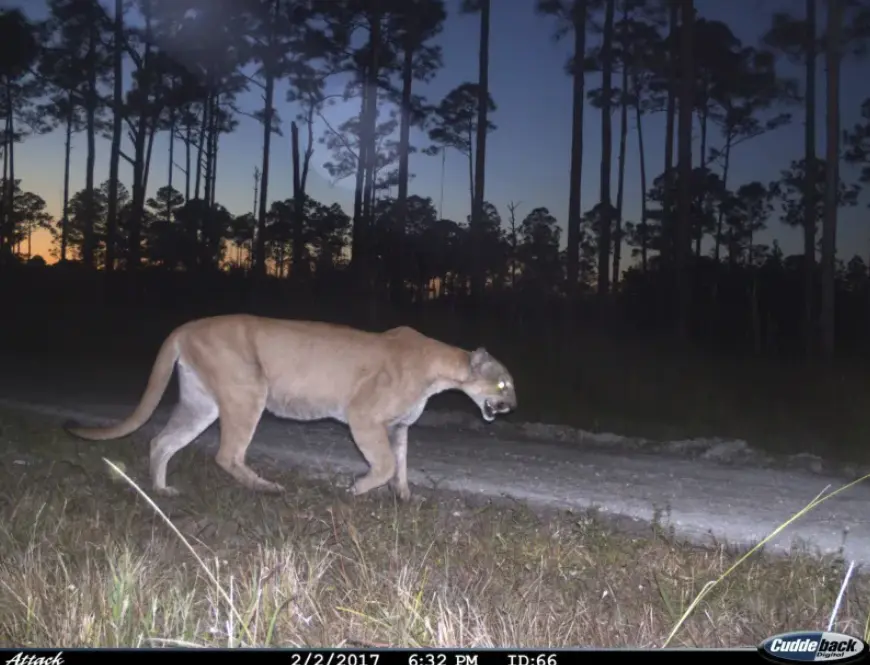
Males, who are more likely to venture into new territory, both to avoid older males and to find mates, had been crossing the river periodically. But there were no females to be found. In 2016, wildlife officials observed a female north of the river — the first in 40 years. And in 2018, photographer Carlton Ward, founder of conservation and storytelling group WildPath, filmed that female rearing kittens.
Ward said that since then, there have been sightings of three or four females north of the river, and in 2022, vehicles killed two females in the area. Another was killed in 2023.
Last week, a 7-month-old male kitten was killed by a vehicle near a creek bed in Glades County, also north of the river, and in April, a male panther was struck and killed north of the river, in Glades County northwest of Lake Okeechobee.
The bulk of the 2024 documented mortalities occurred in Collier, Lee and Hendry Counties, and one death occurred in Broward County, on I-75.
Not all of the 2024 documented deaths are from vehicle strikes. Two kittens were killed in Okaloacoochee Slough Wildlife Management Area by a predator — the FWC did not indicate what kind, and four died of unknown causes.
Wildlife officials estimate that there are only around 200 or 230 Florida panthers left.
That’s up from around 20 animals in the late 1960s. Inbreeding geographic isolation damaged the health of the surviving cats, and in 1995, wildlife officials decide to introduced eight female panthers from Texas, the region with the most similar genetics, to strengthen the South Florida population. By 2007, the Florida population had tripled to about 100 animals.
Traci Deen, CEO of Conservation Florida, told McClatchy News that development in previously rural areas has brought more panthers into contact with humans.
“And unfortunately, in the panther’s case, we’re seeing a higher number of deaths, and that’s really problematic when there are only so many of them left in the world,” Deen said. “So when we have a population of only about 200 give or take, and we lose over 30 in just one year, we have to stop and ask, what are we doing?”
Conservation Florida facilitates land deals and conservation easements that protect water, land and wildlife as the state’s population expands.
“We are not going to stop the growth of our state, and in many ways, growth is a good thing,” she said. “But as we grow, we have to increase the pace of land conservation, or we will lose species like the Florida panther.”
Wildlife corridors and wildlife crossings are two tools the state is using to give panthers and other wildlife a chance at survival.
The Florida Wildlife Corridor, which Ward and his team at WildPath helped champion, is a patchwork of national parks, preserves, state park and private land, such as cattle ranches, that creates a corridor of open space that weaves up the state from the Everglades to wild areas near Orlando, Jacksonville and Tallahassee.
Currently, 10 million of the planned 18 million acres of the corridor are protected. The remaining 8 million acres are up for grabs, but the state and conservation nonprofits hope to convince land owners to take conservation easements or sell to the state as opposed to developers.
What else can be done?
Two key solutions are car speed and wildlife crossing.
Totoiu said that the Florida Department of Transportation can and does set lower nighttime speed limits for certain roads based on wildlife risk. And they are experimenting with a sensor system that tells drivers when wildlife is near the road.
“Even a modest reduction in speed can really save the life of so many animals because speed is the critical factor,” he said.
Another step is to give animals a way to travel either under or over the road. “The (Florida Wildlife) corridor can only do so much if it’s bisected by roads,” said Totoiu. “If the corridor is carved up by roads and we don’t have these crossings in place for panthers to utilize, it’s going to erase any gains we’ve made with land acquisition.”
The state has built 60 wildlife crossings or bridges that have been modified for use by panthers on Florida’s roads. Twenty-four of those are on a 40-mile stretch of I-75.
But Jason Totoiu, senior attorney for the Center for Biological Diversity, says there needs to be many more. There’s a well-documented lack of funding, he said. “Unlike many states in the country, we don’t, in Florida, have a dedicated source of funding for wildlife crossings on an annual basis.”
He feels for the Department of Transportation. “They really have to search high and low, instead of having a dedicated funding stream that allocates $6 to $8 million, where they can knock out one of two of these crossings a year.” He said annual funding has been a great success in Western states.
Ward and his team recently won an Emmy for best nature documentary for his film, “Path of the Panther,” which documented his quest to film the female north of the Caloosahatchee River. He sees the most recent death in two ways.
“It’s tragic to lose a panther, but at the same time it shows that the Florida Wildlife corridor is working,” Ward said. “That cat was probably born south of the Caloosahatchee River, and found its way across, and found habitat to live and hunt and exist north of the river. That’s exactly what we need — more panthers reclaiming their homeland in the northern Everglades and beyond. That’s what it’s going to take to get the species to recovery.”
Ward said the next high-profile Florida Wildlife Corridor wildlife crossing that’s coming online is about 100 miles north of the Caloosahatchee, under Interstate 4, a major highway that connects Tampa to Orlando.
The area has seen skyrocketing development in the last decade or so. But just beyond it is the Green Swamp Wildlife Management Area, and a possible path to the massive Ocala National Forest south of Gainesville.
“That would be a real benchmark if a female panther could make it north of I-4, then that’s a big step forward,” Ward said. “That’s a real challenge, and I’m not sure they’ll make it without our help relocating them. They’ve got to run a gauntlet even to get to the edge of I-4.”
To report a sick or injured panther, contact the FWC’s Wildlife Alert Hotline at 888-404-3922.
Yet another dead Florida panther, this one, expanding range north